
Flux Residue and PCB Cleaning Process Analysis
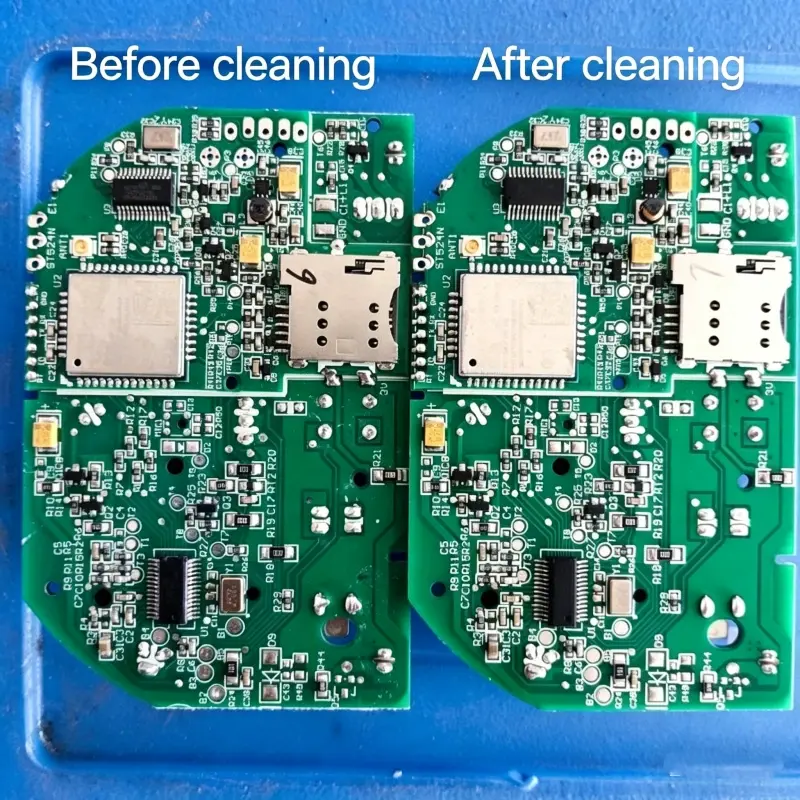
Core Hazards of Flux Residues
Flux is an acidic chemical mixture used in soldering to remove metal oxides and help solder bind. After soldering, flux leaves residues on the PCB and solder joints. These residues can harm reliability. Over time, acidic residues attract moisture and corrode copper and other metals. In humid or hot environments, flux residue can age insulation and cause corrosion. This leads to lower surface insulation resistance (SIR) and even electrochemical migration (ECM) between conductors[1][2]. For example, a case study found heavy no-clean flux residue caused copper corrosion in a 98% humidity environment[2]. As circuits get smaller, even tiny ion traces from flux can form conductive paths. In short, flux residue can cause leakage currents, shorts, and long-term corrosion in PCBs[1][2].
Soldering Methods and Residue Risk
The amount of flux residue depends on the soldering method. There are four common methods:
- SMT Reflow Soldering:Uses solder paste (flux in paste) applied by screen or stencil. This method has the lowest flux-residue risk because the paste amount is tightly controlled[3][4]. Failures from reflow flux are rare (though tight QFN packages may still suffer).
- Full-Board Wave Soldering:Applies liquid flux to many parts of a PCB before passing over a solder wave. This method has a higher risk than SMT, since a large spray of liquid flux is used. Excess flux can flow to areas that stay cooler, leaving acidic residue[4].
- Selective Soldering:Uses localized wave solder and spray flux only on certain areas. Its risk is medium, between reflow and full-wave. If flux spraying is not well controlled, acidic residue can remain under components.
- Hand Soldering:Uses liquid flux by hand. This has the highest risk because flux amount is hard to control. Too much flux is often applied. Extra flux may run under nearby parts or onto the board and be hard to clean[5].
In summary, flux in solder paste (used for SMT) gives the least residue risk[4]. Liquid flux (used in wave or manual soldering) has higher risk because it is hard to meter and can leave more acid. Manual soldering, with hand-applied flux, is especially risky[5]. Understanding each process and controlling flux usage is key to reducing residue problems[3][4].
Flux Basics and Application Methods
Flux Definition. Flux is an acidic mixture of chemicals used in soldering to remove oxides and help solder wet the surfaces[6]. Its job is to clean metal and allow a strong solder bond. Terms like “low activity” and “high activity” describe how aggressive the flux is. But these are not precisely defined in chemistry[7]. In fact, no single test can label flux residue as “benign” or “active,” because the failure risk depends on many factors: flux chemistry, amount applied, circuit design, and environment[7][8].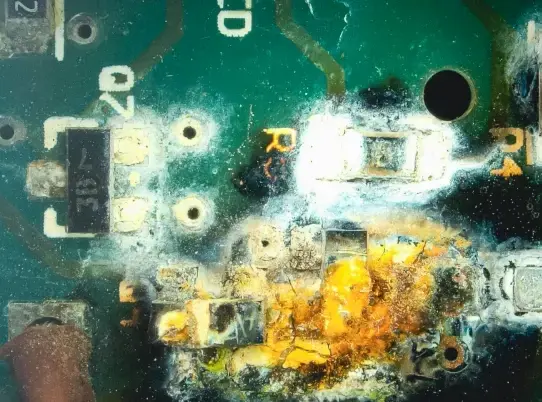
Flux Components. Modern flux contains:
- Activators:usually weak organic acids (e.g. adipic, succinic, glutaric acids). They react with oxides and form metal salts that dissolve, allowing solder to bond[9]. But any activator left over makes the residue acidic and risky.
- Binders (Vehicles):high-melting materials (rosin or synthetic resin) that form the bulk of residue after soldering[10]. They hold activators in place until heated. Low-solids flux has fewer binders and less visible residue.
- Solvents:dissolve flux components into a liquid. They must fully evaporate during soldering. If solvent remains in residue, it raises failure risk[11].
- Additives:small amounts of plasticizers, dyes, antioxidants. They have minor impact on residue risk.
Flux Application Methods. Flux can be applied in four main ways[4]:
- Flux in Solder Paste:Used for surface-mount (SMT). The paste is printed by stencil. This precisely meters the flux and yields the least residue[4].
- Liquid Flux Spray (Wave or Selective):Used to prepare through-hole and mixed assemblies. Flux is sprayed over PCB before wave solder or selective solder. This uses more flux, and any excess or unactivated flux can remain on cooler parts of the board[4].
- Liquid Flux (Manual):Flux brush or syringe in hand soldering. The flux amount depends on the operator. This is hardest to control. Too much flux leads to residue spread under parts or onto solder joints[5].
- Flux in Solder Wire (Flux Core):The solder wire or bar contains a controlled amount of flux. It produces moderate residue localized at each joint.
In practice, solder paste flux gives the lowest risk because a screen or printer controls its amount[4]. Liquid flux (sprayed) brings higher risk: if over-sprayed, it can leave more acid and flow to non-heated areas[4]. Hand-applied liquid flux is most problematic: human error can lead to excess flux, which flows under components and is hard to clean[5]. The rule is: less flux = lower residue risk[4][5].
Flux Residue Risk Assessment and Detection
There is no single test that covers all flux residue risks. Instead, multiple methods are used:
- ROSE Test (Resistivity of Solvent Extract):The board is rinsed with a solvent and the resistivity of the extract is measured. This gives an indirect measure of ionic cleanliness (how much conductive residue remains)[12]. ROSE helps check if soldering and cleaning processes were effective.
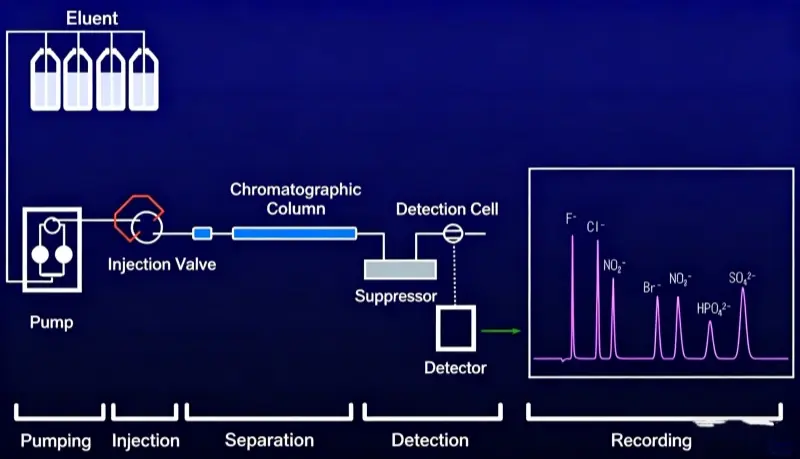
- Ion Chromatography (IC):A direct lab test that identifies specific ions on the board surface. It can measure leftover activator acids, salts, etc[12]. IC is especially useful for liquid-flux processes, because it can detect weak organic acids and other residues. Testing can be done by soaking an entire board (average concentration) or by spot extraction (localized concentration)[13]. Its downside is lack of universal pass/fail criteria; results depend on process and environment[13].
- High-Humidity Environmental Testing:Boards are stressed in hot/humid conditions (like 85°C/85% RH) to reveal if residue is causing leakage or shorts. This simulates worst-case use. If failures occur, they are usually due to current leakage or short circuits. (Using current limiters can prevent board damage but may mask the root cause). This test shows how design and residues behave in real environments[14].
Other key factors affecting flux residue risk include:
- Electrical Spacing (V/mil):Higher voltage per distance on a board means even small ion conductivity can cause breakdown. For example, 5 V across 0.1 mm in high humidity can trigger dendrites and near-zero resistance[15].
- Circuit Sensitivity:High-frequency or high-impedance circuits are very sensitive. In such designs, any ionic residue can disturb signals or create leakage. Engineers often treat all residue as “active” and plan for cleaning.
- Coatings or Encapsulation:Conformal coatings or potting compounds may not stick well to flux residue. Residue under coating can absorb moisture and create a “pressure cooker” of corrosion[16]. Coating on top of active residue can cause delamination or hidden corrosion.
- Operating Environment:Hot, humid, or salty conditions amplify corrosion. Moisture in the air will condense on residue, dissolve ions, and drive electrochemical migration[15]. Long-term, this degrades insulation and causes failures.
Monitoring and limiting these factors (clearance, design, coating quality, use environment) is as important as cleaning in managing residue risk.
Necessity of PCB Cleaning
For high-reliability electronics, thorough cleaning after soldering is essential[17][18]. The main goals of cleaning are:
- Remove Contaminants:This includes flux residues (ionic and acidic), tape adhesive or solder mask glue, dust, oils, and fingerprints. If left, these can corrode component leads, degrade solder joints, or cause shorts[18].
- Prevent Corrosion and Shorts:Ionic residues attract moisture and form conductive paths. Cleaning removes ions like sulfate, chloride, weak acids, etc. This prevents dendrite growth and electrochemical migration that could short circuits[18].
- Ensure Good Test Contact:Test probes must touch pads directly. Any residue can insulate and give false test results.
- Improve Coating Adhesion:Clean surfaces help coatings and adhesives stick properly. Flux residue can impede coating adhesion, leading to peeling or trapped moisture[16].
- Reveal Hidden Defects:Cleaning makes boards look pristine and bright. It also exposes latent issues (burns, delamination, incomplete joints) that cleaning or flux might have hidden.
Types of PCB Contaminants: PCB surface contamination is generally:
- Polar (Ionic) Contaminants:These are water-attracting substances like flux activators, salts, and acids. They conduct electricity when wet, causing leakage and corrosion[19][20].
- Nonpolar (Nonionic) Contaminants:Oils, grease, rosin or other organics. They don’t conduct but impair coating adhesion and look bad[20].
- Particulate Contaminants:Dust, solder balls, fibers. These can cause shorts if large or bridge fine conductors.
In summary, proper cleaning is needed to remove both ionic and non-ionic residue, ensuring reliability. For critical fields (aerospace, medical, military), cleaning after soldering is “non-negotiable”[17]. Even “no-clean” flux residues often must be cleaned in demanding applications[21]. In consumer products, cleaning might be skipped, but in any high-humidity, high-voltage, or safety-critical use, cleaning and testing cleanliness are required.
Mainstream Non-ODS Cleaning Processes
With CFC solvents banned, modern PCB cleaning uses mainly four approaches: water-based, semi-aqueous, solvent, or no-clean processes.
1. Aqueous (Water-Based) Cleaning
Core Principle: Use water with added detergents and chemicals. A typical formulation is water plus 2–10% of surfactant, detergent, corrosion inhibitor, etc.[22]. Heating, brushing, spraying, and/or ultrasonics help the solution penetrate the board. Water-based cleaners dissolve water-soluble flux components and emulsify oils and resins[22].
For rosin-based flux, a saponifier (strong base like NaOH, KOH, or monoethanolamine) is added[23][24]. The base chemically converts rosin acids and oils into soluble soaps. (Because these bases can attack aluminum or zinc, a corrosion inhibitor is also included; boards with alkaline-sensitive parts must use caution[25][26].)
Process: The board is washed in the hot (often ~55–60°C) detergent solution with agitation or ultrasonics (usually ~5 minutes)[22][27]. Then it is rinsed 2–3 times in hot deionized water (to avoid spots)[27]. Finally, boards are dried with hot air (~60°C). Using high-purity DI water is costly but ensures no ionic residue from rinse water[27].
Pros: Water cleaning removes a wide range of polar and non-polar contaminants. It’s effective on most fluxes and grease. It is also generally safe for parts (no flammability).
Cons: It requires large amounts of DI water and drying energy. Drying high-density boards is challenging. Wastewater treatment can be expensive. Also, water-based chemistry can corrode some metals if not formulated properly[25].
2. Semi-Aqueous Cleaning
Core Principle: A mix of water, organic solvents, and surfactants[28][29]. Semi-aqueous cleaners often contain 5–20% water and 80–95% organic solvents (terpenes, petroleum hydrocarbons, glycol ethers, etc.) plus surfactant. The low water content makes them look like clear solvent mixtures[29]. The organic part dissolves rosin and many oils, while the surfactant/water emulsifies them. High-boiling solvents are used so they don’t evaporate easily; cleaning can be done at up to ~70°C (below the solvent flashpoint)[28][30].
Process: Often uses batch machines similar to aqueous ones, with cleaning (sometimes ultrasonic), then rinsing and drying. A key step is an emulsion recovery stage: after cleaning, the still-wet board is passed through an emulsifier tank or filter that separates solvent from water[30]. This prevents the solvent contaminating the rinse water. Then boards are rinsed with water (2–3 times) and dried.
Pros: Semi-aqueous systems handle most fluxes (water- or solvent-based) in one machine. They have strong cleaning power (solvent + emulsifier) and work on many soils. Because most solvents have low vapor pressure, they are safer (less fire risk) than pure solvents. They can often be used on same equipment as water cleaning, reducing investment.[29][31]
Cons: Equipment cost is higher (special tanks, emulsion systems). Fire and explosion precautions are needed. Water rinse still required. The spent solvent/water mix must be treated or distilled, so waste disposal is still a concern. Cleaning agents are not easily recycled unless distilled, which is complex. The process also wastes some cleaning solution when recovering emulsions.
3. Solvent Cleaning
Core Principle: Use pure organic solvents (no water) to dissolve flux and oil. Common solvents now include hydrofluorocarbons (HCFCs like 141b, HFCs like HFE), or newer low-toxicity hydrocarbons and alcohols[32]. Fluorinated solvents have the advantage of being non-flammable and having similar properties to the old CFC-113, so existing vapor-degreasing equipment can often be reused[33]. Mixtures or azeotropes (like HCFC-141b with methanol, HCFC-225 with ethanol) are also used to boost solvency[34].
Process: Typically vapor degreasing: the solvent is boiled in a tank, producing vapor. Boards are hung on a rack and lowered into the vapor. Contaminants dissolve and drip off. Then boards may be soaked in liquid solvent (often with ultrasonic agitation), followed by a cold solvent rinse (spray) to remove any residue. Finally, boards are dried by vapor condensation and hot air. No water is used, so drying is quick. Spent solvent can be distilled and reused.
Pros: Simple and fast. Solvent dries quickly by evaporation. Good for moisture-sensitive or coated boards. Solvents can be reclaimed by distillation, reducing waste. Little equipment change needed from old CFC systems[33].
Cons: Many solvents are toxic or regulated for greenhouse impact. Equipment must be explosion-safe. Disposal of spent solvent (or fines in distillation) still requires care. Some sensitive components or plastics may not tolerate certain solvents or vapors.
4. No-Clean Process
Definition: A manufacturing process designed so that no post-solder cleaning is needed. It relies on controlling flux, process, and materials so that the small amount of flux residue left is not harmful in the end-use environment. No-clean is “clean” in terms of process design, not that it literally cleans automatically. It cuts cost and is eco-friendly (no wash chemicals). This approach is best for high-volume, automated assembly of boards that do not have extreme reliability needs. Key controls are:
- Flux and Solder Selection:Use no-clean flux or low-solids flux with weak organic acid (WOA) activators. Often these fluxes are low in solids, leaving minimal residue. If coatings are applied later, a very low-activity (or nitrogen-protected) flux might be chosen so residue remains as inert as possible. For standard consumer electronics, a mildly active rosin flux (RMA) can be used.
- Process Optimization:Spray flux as precisely as possible (e.g. controlled volumetric spray) to use the least needed. Use nitrogen in reflow or selective machines to reduce oxide formation (so flux needs less work). Adjust the soldering profile so that flux activators are fully consumed at peak temperature. For any rework or manual soldering, use no-clean flux or flux-cored wire to keep consistency.
- Material Quality:Ensure bare boards and components are very clean before assembly. Work with stable flux and solder suppliers so the chemistry is consistent. Also ensure any protective coatings applied post-solder can tolerate the residue (some require specific chemistry to adhere).
Even when skipping wash, process control is vital. For example, inspectors may still measure ionic cleanliness on some boards to validate the no-clean process.
Choosing a Cleaning Process
The choice of cleaning method depends on the product’s importance, design, and environment. Key factors:
- Product Criticality and Environment:If the board is in aerospace, military, automotive safety, or medical equipment, it must be very clean[17]. High humidity or marine environments require stringent cleaning and cleanliness control. Consumer gadgets (class 1) can often use no-clean flux. Commercial products (class 2) might require routine checks. Industry standards (like IPC/J-STD-001) divide assemblies into classes: Class 3 (“high performance” or life-support) typically requires cleaning and purity testing on every board; Class 2 allows some sampling tests; Class 1 (general) may allow no-clean with basic inspection. In practice, designers should aim to meet at least Class 2 cleanliness for most products.
- Flux Chemistry:Highly active or corrosive flux residues demand aggressive cleaning. Water-soluble fluxes (organic acids) must be washed off to prevent corrosion. No-clean or weak-activity fluxes leave less harmful residue, so milder cleaning or no cleaning is possible[21]. For any flux with halides, chlorides, or strong acids, full aqueous cleaning is needed.
- Customer/Contract Requirements:Many contracts or standards explicitly state cleaning requirements by product class. Always follow customer specs or applicable standards (e.g. J-STD-001, MIL-SPEC) for cleanliness.
- Other Environmental Factors:If conformal coatings will be applied, ensure chosen cleaning (or no-clean) is compatible. Wet or coated conditions may be tricky.
In summary, high-reliability boards in harsh environments should be cleaned thoroughly and tested for ionic levels. Less critical boards can use no-clean processes with periodic checks. As one source notes, the cleaning method “should be based on the product importance, required cleanliness, and plant situation”.
New Alternative: Dry Ice Cleaning
Dry ice blasting is an emerging, eco-friendly PCB cleaning method. It uses compressed air to shoot solid CO₂ pellets at high speed onto the PCB surface. When pellets hit the board, they instantly sublimate (turn to gas) and impart a strong impact and cooling effect on the residue[35]. This kinetic-and-thermal action breaks the bond between contaminants and the board surface. It makes flux residue and other soils brittle and dislodges them. Because CO₂ simply turns to gas, it leaves no secondary waste on the board[35]. One report notes that dry ice cleaning can remove over 95% of solder flux contamination from test boards[36].
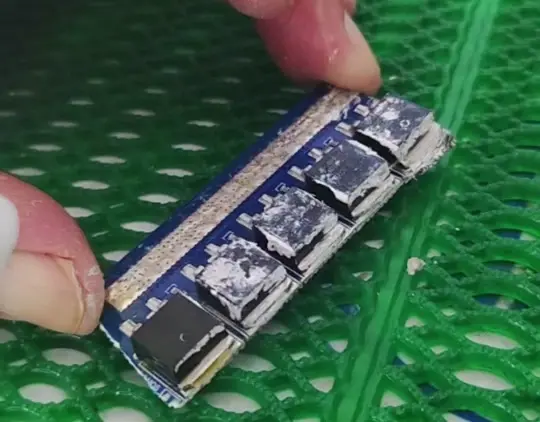
Key comparisons with traditional cleaning:
- Cleaning Efficiency:Dry ice blasting is reported to be very fast – up to 4 times faster than some solvent or aqueous methods. It can clean quickly without soaking or long cycles.
- Residue and Waste:It produces no liquid effluent. The only “waste” is the dislodged contaminants, which must be vacuumed away. The dry ice (CO₂) itself vaporizes into air, leaving the board completely dry. This avoids handling toxic wash chemicals or wastewater.
- Cleaning Effect:Dry ice pellets can reach into tiny crevices and under components that liquid cleaners may not wet. Its precision blasting can clean complex assemblies thoroughly[37]. Studies show it removes flux without reducing the solderability of the finish[38].
- Board Safety:Dry ice is non-abrasive and non-conductive. It will not damage delicate components, wires, or circuit traces[35]. A source notes it “lifts away dirt and debris without residue” and “no mechanical damage to delicate surfaces or intricate components”[35]. It is so gentle that it can even be used on powered electronics if the setup is safe.
- Environmental Impact:Dry ice cleaning is considered green. It uses recycled industrial CO₂ and adds no toxic chemicals. There is no hazardous waste to dispose of[38][35]. The only byproduct is the removed dirt, which is inert.
- Safety:CO₂ pellets are cold but non-toxic and leave no harmful residues. There are no fire or explosion hazards (unlike solvent vapors). Operators must use respiratory protection due to CO₂ gas levels, but generally the method is safe.
- Cost:The main costs are dry ice supply and compressed air. No-cleaning chemicals or wastewater disposal costs are saved. Labor can be lower due to fast cleaning. Many find the overall cost competitive, especially when factoring in time saved and higher throughput.
In summary, dry ice blasting offers an effective, residue-free clean. It eliminates many drawbacks of wet cleaning: no secondary pollution, no liquid waste, and no damage to boards. As one conference paper concludes, it is “innovative, inexpensive, and green” and can remove flux residue very effectively[38][36]. Many users report that dry ice blasting achieves superior cleaning, especially for sensitive electronics, without risk to the PCB.
Table of Contents
Related Posts

PCBA Prototype
April 6, 2025