
A Complete Guide to PCB Via and Stack-Up: Through Via, Blind Via, and Buried Via

In modern electronics manufacturing, PCB design and production have become more precise and complex. Whether you are an engineer, a project purchaser, or a business looking for a reliable PCB factory or PCBA factory, understanding vias and layer stack‑up is essential to ensure high quality PCB manufacturing and stable PCB performance. This article explains PCB vias and stack‑up in clear, practical terms, helping you make better decisions when working with PCB assembly factory and PCBA suppliers.
PCB Stack Up
What Are PCB Vias and Stack‑Up?
A multilayer PCB is built by laminating substrate cores and PP (prepreg) sheets together. Different copper layers carry signal traces, power lines, and ground planes. To connect these layers electrically, we use conductive channels called vias. You can think of vias as small “pipes” that transmit signals and power vertically between layers.
PCB stack up refers to the layered structure of a multilayer circuit board, including the arrangement of copper layers, dielectric materials, and via types. A reasonable stack up design improves signal integrity, reduces interference, and optimizes space. For example, a typical 6‑layer HDI board uses a 2+N+2 structure with mechanical drilling and laser drilling to achieve high density interconnection.
Vias are divided into metalized vias (conductive) and non metalized vias (non conductive). Non metalized vias have no copper plating on the hole wall and are often used for structural positioning, fixing, or heat dissipation. Most vias used for electrical connection are metalized vias, also known as conductive vias.
There are three main types:
1.Through Hole (PTH)
2.Blind Via Hole (BVH)
3.Buried Via Hole (BVH)
1. Through Hole (PTH) – The Most Common and Cost‑Effective Via
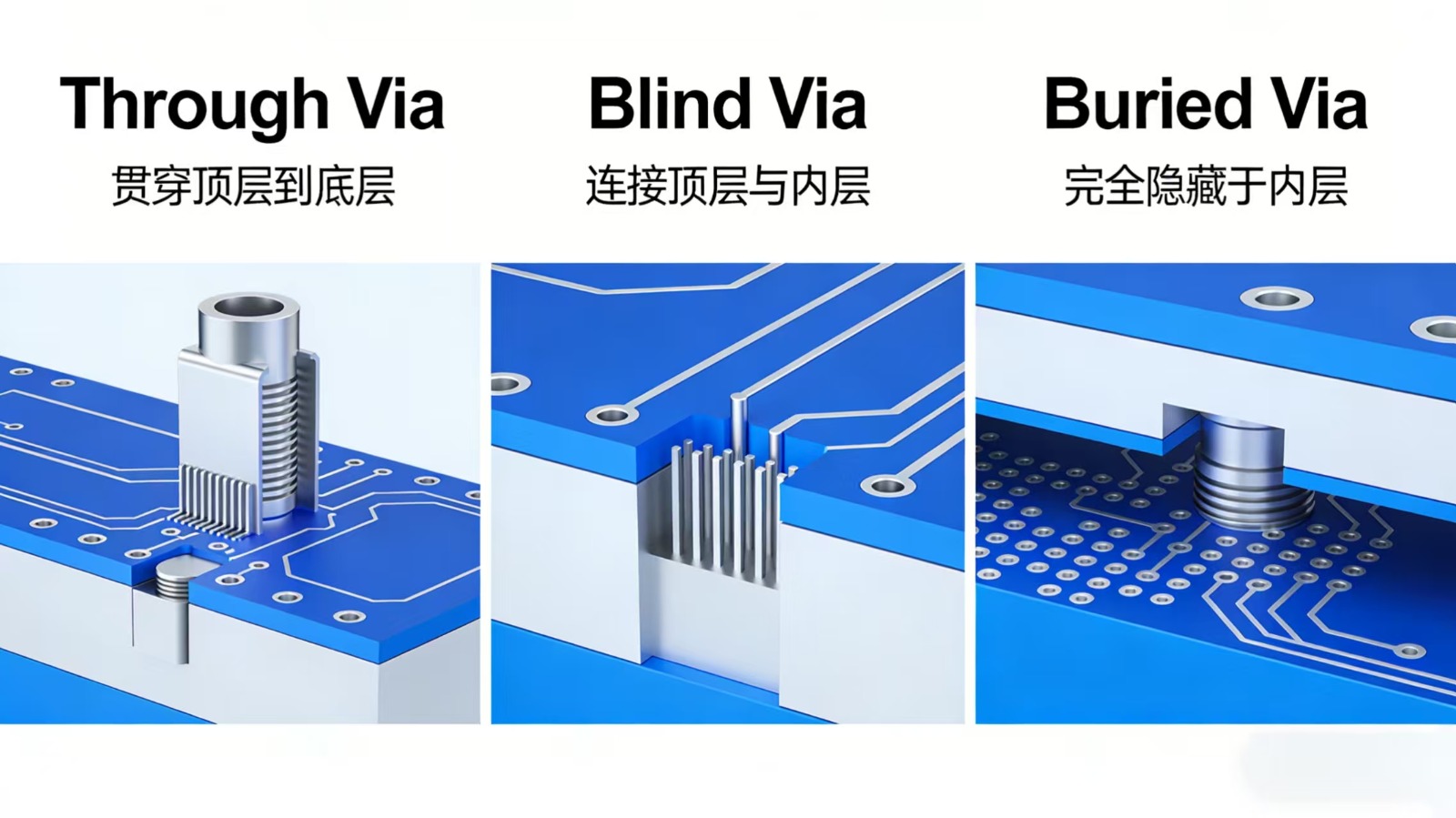
Plating Through Hole (PTH) is the most widely used vias in standard PCB production. It penetrates from the top layer to the bottom layer, connecting all layers in between.
Features
1.Simple structure, mature manufacturing process
2.Low cost, high reliability, suitable for mass production
3.Easy to inspect and repair
Limitations
Because it runs through the entire board, it occupies routing space on every layer. In high‑density designs with dense BGA chips, through via take up too much surface area and make fan‑out routing difficult.
Application
2‑layer boards, simple multilayer boards, consumer electronics, power boards, and low‑density control boards.
For cost‑sensitive projects, a professional PCB factory will recommend through vias to balance performance and budget.
2. Blind Via – Connect Surface Layers to Inner Layers
A Blind Via starts from the top or bottom surface and connects to one or more adjacent inner layers, but does not go through the entire board. It is visible on one side only.
Features
1.Saves surface space compared to through vias
2.Improves wiring density, ideal for HDI boards
3.Supports BGA fan-out and miniaturization
4.Usually formed by laser drilling or controlled depth drilling
Analogy
If you own floors 5–6 in an 8‑story building, a blind via is like a staircase that only connects floor 5 to 6, without running through all floors. It does not waste space on other layers.
Application
Mobile devices, wireless modules, automotive electronics, high‑speed cameras, and compact IoT devices.
Leading PCBA suppliers often use blind vias to help customers achieve smaller form factors and better performance.
3. Buried Via – Hidden Interconnection Inside the PCB
A Buried Via exists only between inner layers and is invisible from the top or bottom surface. It is fabricated during inner‑layer lamination, before the outer layers are pressed together.
Features
- Completely hidden inside the board
- Frees up all surface space for components and routing
- Supports ultrahigh density design
- Improves signal integrity for high-speed circuits
Limitations
Complex manufacturing process, requires multiple lamination and precise alignment. Costs are higher than through vias and blind vias.
Application
High‑end servers, medical equipment, aerospace electronics, 5G communication devices, and high‑speed AI computing boards.
A professional PCB assembly factory with advanced capabilities can stably produce buried via while ensuring yield and reliability.
Why Via and Stack‑Up Matter for PCB and PCBA Manufacturing
PCB via and stack‑up directly affect:
- Board size and miniaturization
- Signal quality and ant interference ability
- Production cost and delivery time
- Yield rate and long-term stability
For example:
- Low-density products: use through via to reduce cost.
- Medium density products: combine through vias and blind vias.
- High-speed / high-density products: use blind vias + buried vias + HDI stack‑up.
When choosing a PCB factory or PCBA factory, you should check whether they can provide DFM (Design for Manufacturing) suggestions, optimize via types and stack‑up, and avoid production risks.
How to Choose the Right Via Type for Your Project
- If you need low cost and short lead time → choose through vias.
- If you need compact size and BGA routing → choose blind vias.
- If you need ultra‑high density and high speed → use buried vias + blind vias.
- Always confirm process capability with your PCBA suppliers before finalizing design.
PCB Through Villa
Conclusion
PCB vias and stack‑up are the foundation of high‑quality PCB manufacturing. Through vias provide cost efficiency, blind vias support space saving, and buried via enable advanced high‑density design.
Whether you are developing a new product, optimizing an old design, or looking for a stable one‑stop PCB factory and PCBA factory, understanding vias helps you communicate clearly, avoid unnecessary costs, and ensure your boards meet performance and reliability standards.
If you need professional PCB/PCBA support, our team provides full‑process DFM analysis, stack‑up optimization, and stable mass production for global clients. We are committed to being your trusted partner in PCB and PCBA manufacturing.
Table of Contents
Related Posts

PCBA Prototype
March 27, 2026
PCBA Prototype
March 22, 2026