The Role of Bypass and Decoupling Capacitors in PCB Design

In electronics, capacitors are crucial for ensuring the stability and reliability of PCBs. You might frequently see 0.1uF and 0.01uF capacitors used around chips as bypass and decoupling capacitors. Why are these specific values important? To answer this, let’s explore the concepts of bypass and decoupling capacitors and the characteristics of capacitors.
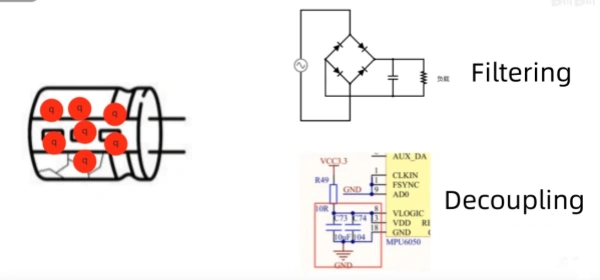
Capacitor Characteristics
Capacitors store electrical charge and are used for filtering in power supplies. An ideal capacitor is a perfect charge storage device, but real capacitors have additional characteristics, such as equivalent series resistance (ESR) and equivalent series inductance (ESL):
- ESR affects power ripple.
- ESL affects the capacitor’s frequency response.

Bypass and Decoupling Capacitors
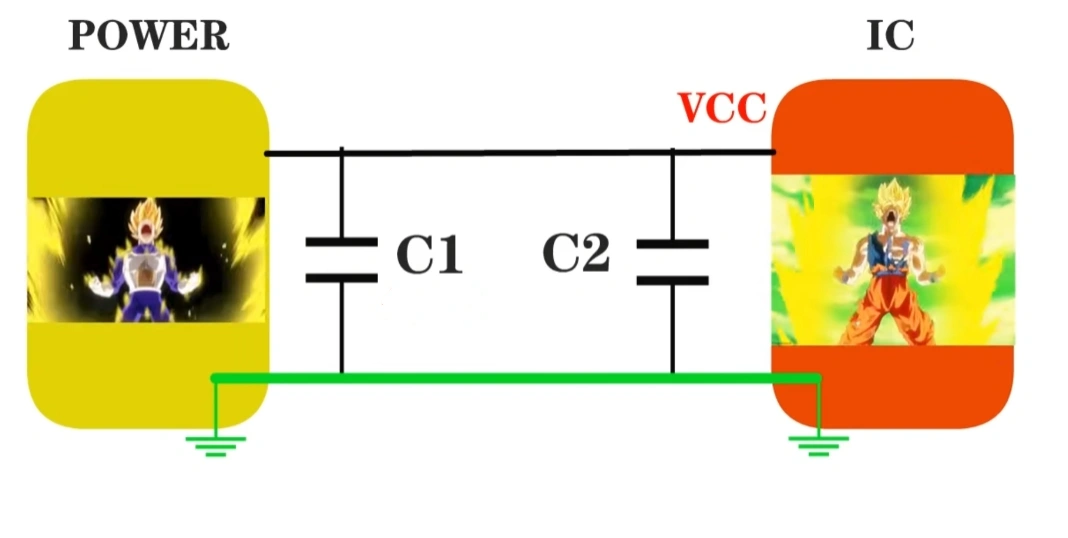
Understanding these terms, let’s see their application in circuits. A DC power supply (Power) provides power to an IC. In the circuit, two capacitors are connected in parallel. If the power supply experiences interference, especially high-frequency interference, it can affect the IC’s operation. By placing a capacitor (C1) near the power source, the capacitor acts as a bypass capacitor because it appears as an open circuit to DC and presents a low impedance path for high-frequency interference. This interference, which would otherwise pass through the IC, is shunted to ground through C1, thus bypassing the IC.
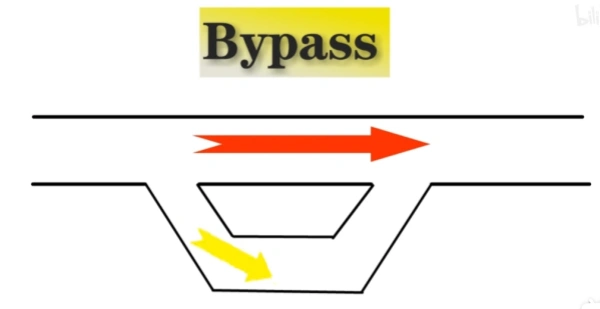
Since integrated circuits (ICs) typically operate at high frequencies, when the IC starts up or switches frequencies, it can create significant current fluctuations in the power lines. This interference can directly affect the power supply, causing fluctuations. Placing a capacitor (C2) near the IC’s VCC supply port helps to provide instantaneous current due to the capacitor’s energy storage capabilities, reducing the impact of current fluctuations on the power supply. Here, C2 functions as a decoupling capacitor.
Why Use 0.1uF and 0.01uF Capacitors?
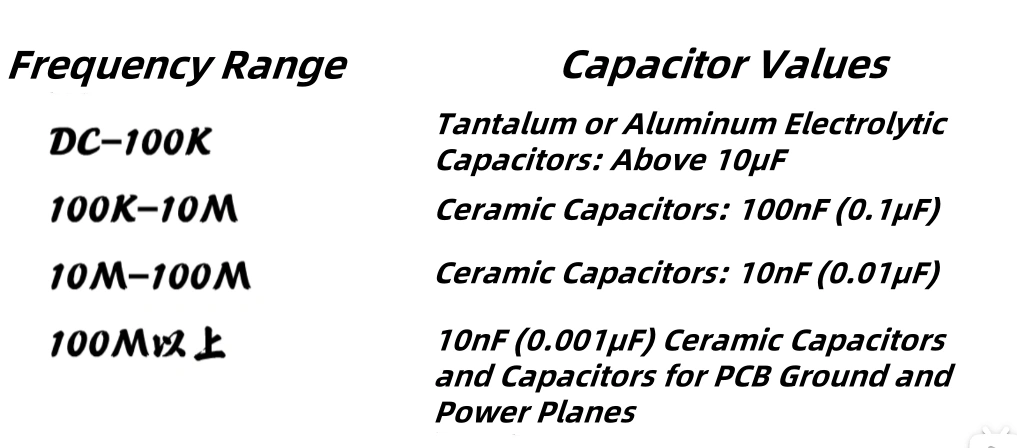
You might wonder why both 0.1uF and 0.01uF capacitors are used. The key lies in the capacitor’s frequency response:
- Capacitive Reactance: Reactance is inversely proportional to both capacitance value and frequency. Larger capacitors have lower reactance at higher frequencies, making them more effective for filtering. Therefore, using a 0.1uF capacitor for bypassing and a 0.01uF capacitor for additional filtering is not wasteful. It helps to widen the filtering frequency range.

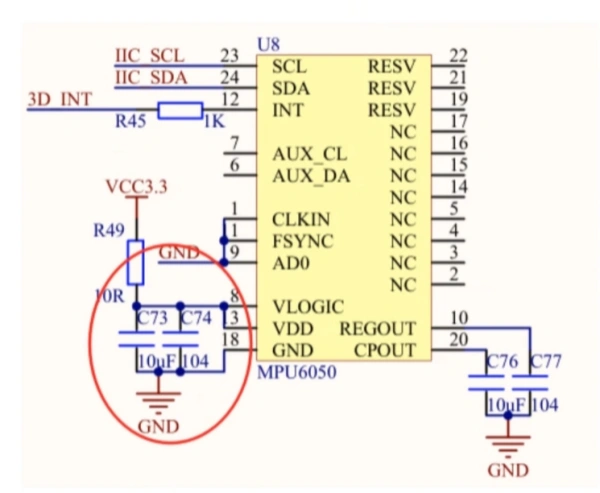
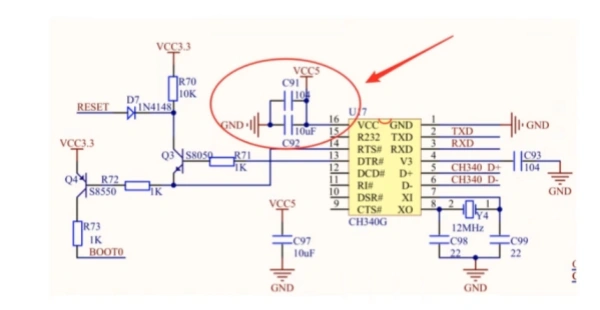
In actual circuits, the frequency range that needs decoupling is often broad, so a single capacitor might not suffice. Common solutions include:
- Using a large capacitor and a small capacitor in parallel.
- Using multiple identical capacitors in parallel.
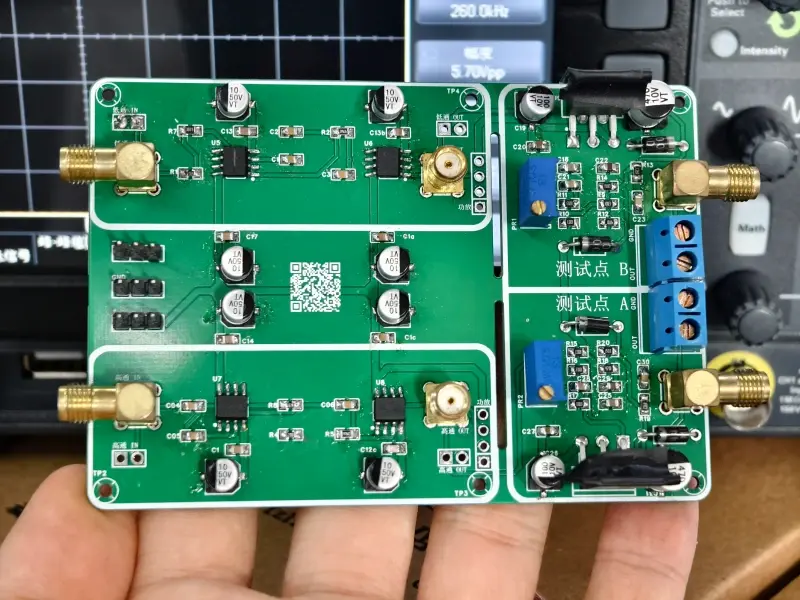
The image below shows various decoupling methods used in module chip circuits for reference.

Capacitor Selection Tips
Understanding these principles helps in selecting capacitors effectively. Avoid using only 0.1uF capacitors in all situations, as they may not be effective in high-speed systems.
Experience Sharing:
- Ideal capacitors have zero resistance and zero inductance, only capacitance. Real capacitors, however, exhibit resistance and inductance, equivalent to an ideal capacitor in series with resistance and inductance. This resistance lowers the quality factor and filter effectiveness, while inductance can cause resonance and capacitor failure.
- Resistance and inductance decrease with parallel connections, while capacitance increases. Thus, when capacitors are connected in parallel, their equivalent resistance and inductance decrease, and the resonance frequency increases, improving the quality factor and making the capacitor’s characteristics closer to an ideal capacitor. Generally, two 1uF capacitors in parallel will perform better than a single 2uF capacitor.