
Can Ferrite Beads Be Used to Connect Two Grounds?

Introduction: The Use of Ferrite Beads in Electronic Circuits
Ferrite beads are widely used components in electronic circuits, particularly for power supply filtering, signal transmission to prevent high-frequency interference, and EMI (electromagnetic interference) protection. However, do we fully understand how ferrite beads work? Here’s a question: while it’s common to see ferrite beads used on power rails, it’s rare to see them used to connect ground lines. Why is this the case?
Structure of Ferrite Beads
The structure of a ferrite bead is simple: it consists of a conductor passing through a ferrite core. A surface-mount ferrite bead is essentially a coil of wire wound several times around the core. The ferrite material used in the bead is a ferrimagnetic compound made from iron-magnesium or iron-nickel alloys with a cubic crystal structure. The manufacturing process and mechanical properties are similar to ceramics, with the material being dark gray in color. Ferrite materials are characterized by high magnetic permeability and high frequency losses, making them ideal for high-frequency applications.

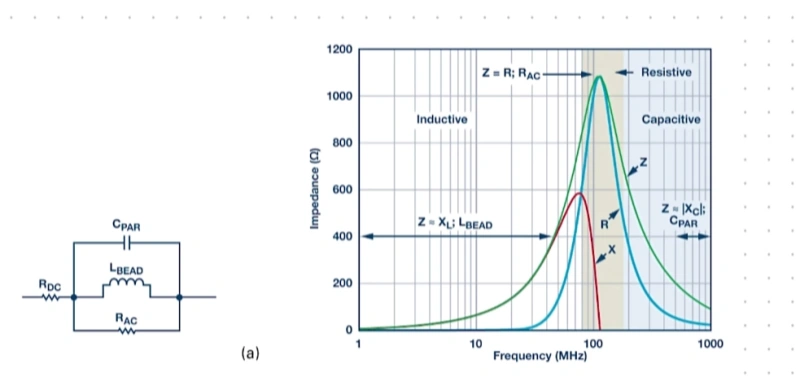
From an electrical perspective, ferrite beads have very low DC resistance, which is often negligible. At low frequencies, they behave like an inductance, with impedance primarily determined by the inductance. Due to the high permeability of the ferrite core, even though the wire only passes through the core once, the inductance is still significant. High-frequency current passing through the wire is suppressed, and the core’s losses are low, resulting in a high Q-factor. When the ferrite bead is used in conjunction with a capacitor to form a low-pass filter, resonance can sometimes occur, amplifying interference noise. In such cases, damping measures must be taken to ensure proper function.
At higher frequencies, the losses in the ferrite core become more pronounced, with the impedance now primarily due to resistive losses. The magnetic permeability of the core decreases as the frequency increases, which reduces the inductance. However, the overall impedance still increases due to the increase in resistive losses. As the frequency continues to rise, the ferrite core loses its ability to absorb high-frequency magnetic fields, and the bead behaves more like a capacitor. This results in a decrease in impedance at very high frequencies, causing the bead to act more capacitively.
In general, ferrite beads are used to suppress high-frequency noise. For this purpose, they must operate in the resistive region of their impedance curve. The resistive region appears after the bead’s “turnover frequency,” where the inductive reactance and resistive reactance are equal. The resistive region extends until the ferrite bead becomes capacitive.
Sometimes, ferrite beads are used in conjunction with capacitors to form low-pass filters. In this case, the ferrite bead must be used in the inductive region, and the operating frequency must not exceed the turnover frequency. In this region, the inductance of the bead is typically between 10-90nH, and using a ferrite bead instead of an inductance has advantages: ferrite beads have a high Q-factor and are much cheaper than inductors.
Can Ferrite Beads Be Used to Connect Ground?
Most people use ferrite beads to connect grounds with the intention of isolating high-frequency interference from one ground plane to another. For example, isolating digital ground from analog ground or isolating sensitive circuit grounds from high-current power circuits. However, placing ferrite beads on ground lines could cause issues. Let’s analyze why this happens.
Ferrite beads on the ground line are not zero impedance; in fact, they increase the return path impedance, which could lead to ground bounce or noise. Therefore, connecting ground lines with ferrite beads can potentially cause problems, though not always. In some special cases, using ferrite beads on the ground may not be an issue. For example, if the signal is transmitted in differential form, rather than using ground as a reference, or in cases like electrical isolation systems, using ferrite beads on the ground may not cause problems.
In any case, whether or not to use a ferrite bead on the ground depends on the purpose. It’s essential to remember the different behaviors of ferrite beads under DC and high-frequency conditions.
Note: In some cases, ferrite beads can be used instead of Schottky diodes. However, they can introduce DC ground loops, which can be troublesome in precision systems. A ferrite bead can provide a DC connection between two planes while isolating them at frequencies above a few MHz, where the bead becomes resistive. However, these DC ground loops may not be suitable for high-resolution systems.
Real-World Example: Grounding Issues in an ADC Circuit
In one product, an ADC chip’s analog ground and the system’s digital ground were connected through a ferrite bead. After thunderstorms, the ADC chip frequently malfunctioned. Upon analysis, it was discovered that during thunderstorms, strong interference signals traveled through the external analog sensor ground and reached the ADC chip’s analog ground. The interference needed to be dissipated through the path with the least impedance. However, the ferrite bead’s impedance at high frequencies was so high that the signal could only dissipate through the ADC’s analog ground pin, which eventually damaged the chip.
Further investigation revealed that the ADC’s datasheet stated that the analog ground pin was internally connected to the digital ground pin via a very low-value resistor. The strong interference burned out this resistor, causing the ADC to malfunction. The solution was to remove the ferrite bead and short the connection with solder, which resolved the issue.
This real-world case serves as a valuable reference for considering when and where to use ferrite beads in circuit design.
Conclusion
Ferrite beads are useful components for filtering high-frequency noise, but their behavior varies depending on frequency and their placement in the circuit. While ferrite beads are commonly used in power lines for EMI suppression, their use in grounding circuits must be approached with caution. Understanding their characteristics and behavior at different frequencies is crucial to ensuring their proper function in the circuit. Always evaluate the specific requirements of your design before deciding to use a ferrite bead in ground connections.
Related Posts

PCBA Prototype
April 6, 2025

PCBA Prototype
March 25, 2025