Considerations for PCB Selection and the Transition from Microwave to Millimeter-Wave Frequency Design

The millimeter-wave frequency band is gradually being adopted by more applications due to its greater bandwidth advantages. Developers of circuits for emerging applications, such as 5G wireless networks and Advanced Driver Assistance Systems (ADAS) in automobiles, are facing the challenge of designing and manufacturing practical solutions for circuits operating at 30 to 300 GHz. This article, divided into two parts, explores the transition from microwave to millimeter-wave frequency design. Part One focused on how to make the transition, while Part Two examines how different circuit technologies and materials commonly used at microwave frequencies affect the performance of high-frequency millimeter-wave circuits.
Signal Frequencies in Automotive Radar
In automotive radar applications, signal frequencies range between 30 and 300 GHz, and can even go as low as 24 GHz. These signals propagate through various transmission line technologies, including microstrip lines, stripline, substrate integrated waveguides (SIW), and grounded coplanar waveguides (GCPW). These transmission line technologies, shown in Figure 1, are typically used at microwave frequencies but are also applied at millimeter-wave frequencies. They require circuit laminates specifically designed for these high-frequency conditions. Each transmission line has its own advantages and disadvantages.

#Figure 1
Microstrip Lines: Simple but Challenging for Millimeter-Wave Frequencies
Microstrip lines are the simplest and most commonly used transmission line technology in microwave circuits. They can achieve a relatively high circuit yield with conventional processing techniques. However, when the frequency is raised to millimeter-wave levels, microstrip lines may not be the best choice for circuit transmission.
Key Challenges for Microstrip Lines:
- Radiation Losses: Due to the open structure, microstrip lines radiate into the surrounding air, causing electromagnetic energy loss. This radiation loss increases with frequency.
- Material Considerations: At millimeter-wave frequencies, low dielectric constant (Dk) materials are preferred to mitigate radiation loss and enhance performance.
- Manufacturing Sensitivity: Microstrip lines require strict tolerance control. As the frequency increases, even small variations in conductor width, dielectric thickness, and copper surface roughness can cause significant performance issues.
The radiation losses and the influence of the surrounding air complicate the design of microstrip circuits at millimeter-wave frequencies. Therefore, higher Dk materials can be used to reduce radiation losses, but increasing Dk can also slow down signal propagation, introducing phase shifts.
Stripline: Reliable but with Manufacturing and Performance Challenges
Stripline is a reliable circuit transmission line technology, known for excellent circuit isolation. It works well at millimeter-wave frequencies but has challenges compared to microstrip lines.
Key Features of Stripline:
- Isolation: The conductor in stripline is fully surrounded by dielectric, preventing electromagnetic waves from radiating into the surrounding air. This structure provides better signal integrity.
- Manufacturing Issues: The connectors for stripline circuits are more difficult to design, especially at millimeter-wave frequencies, where connectors become very small.
- Signal Feeding Difficulties: The difficulty of feeding signals into stripline circuits, coupled with variations in the manufacturing process, makes stripline less suitable for some millimeter-wave applications.
Stripline’s dielectric confinement helps to minimize loss but limits its use in automotive radar or other millimeter-wave applications requiring small connectors or precise signal feeding.
Substrate Integrated Waveguides (SIW): Low Loss but Strict Manufacturing Requirements
Substrate Integrated Waveguide (SIW) is a technology used to design both active and passive circuits, including resonators and filters in automotive radar applications. SIW structures can maintain low-loss signal propagation at millimeter-wave frequencies, but they come with their own set of challenges.
Key Features of SIW:
- Low Losses: SIW structures offer low-loss signal transmission due to their waveguide-like structure.
- Manufacturing Precision: The structure requires highly precise drilling for plated through-holes (PTH), which must be made with very tight tolerances, especially at higher frequencies.
- Material Selection: The materials used in SIW circuits must have minimal Dk variation to maintain performance consistency at millimeter-wave frequencies.
While SIW is effective for some applications, its manufacturing complexity and sensitivity to variations in the drilling process make it challenging to implement in certain circuits.
Grounded Coplanar Waveguides (GCPW): Consistent Performance with Strict Control
Grounded Coplanar Waveguides (GCPW) are widely used in RF, microwave, and millimeter-wave circuits due to their symmetric structure and low-loss performance. These circuits are commonly used in testing and measurement applications across a broad frequency range.
Key Features of GCPW:
- Low Loss Performance: The co-planar structure of GCPW ensures minimal electromagnetic interference and low-loss signal transmission at high frequencies.
- Manufacturing Control: Like microstrip and SIW circuits, GCPW circuits require strict control over manufacturing variables, such as conductor width and thickness, and precise PTH positioning.
- Sensitivity to Material and Process Variations: The performance of GCPW circuits is highly sensitive to material properties (like Dk) and manufacturing process variations. Even small deviations can lead to significant changes in performance at millimeter-wave frequencies.

The Impact of Plating on Circuit Performance
The choice of plating materials plays a crucial role in the performance of millimeter-wave circuits. Plating can introduce additional losses, which are particularly noticeable in GCPW circuits.
Key Considerations for Plating:
- Nickel vs. Copper: Nickel has higher losses than copper, which can degrade the performance of millimeter-wave circuits. For example, the Electroless Nickel Immersion Gold (ENIG) plating can significantly affect the performance of GCPW circuits more than microstrip lines.
- Plating Thickness: Variations in plating thickness can result in phase response changes, which are more pronounced at millimeter-wave frequencies. This makes it critical to control the plating process tightly.
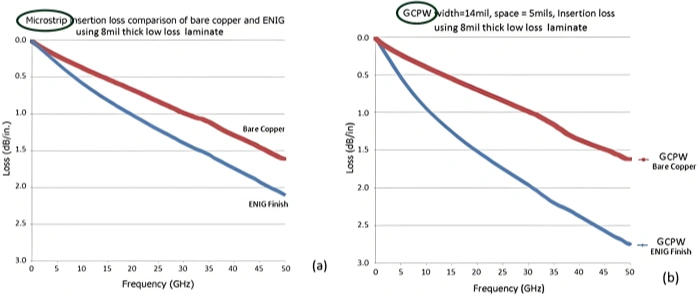
#Figure 3
Figure 3 shows a comparison of microstrip and GCPW circuits using the same circuit material (Rogers’ 8mil thick RO4003C™ laminate), demonstrating the impact of plating on performance at millimeter-wave frequencies.
Conclusion: Balancing Material and Design Choices
As millimeter-wave circuits become more prevalent in emerging applications such as automotive radar, the challenges of designing reliable, high-performance circuits are becoming increasingly complex. Designers must carefully choose from various transmission line technologies—microstrip, stripline, SIW, and GCPW—while considering material properties, manufacturing tolerances, and the impact of plating. Each technology has its advantages and challenges, and careful consideration is required to ensure optimal performance at millimeter-wave frequencies.
For broader High-Frequency PCB guidance, see High-Frequency PCB overview.
Table of Contents
Related Posts
PCBA Prototype
October 19, 2026