
Why Are Most PCBs Green? The Science and History Behind PCB Colors

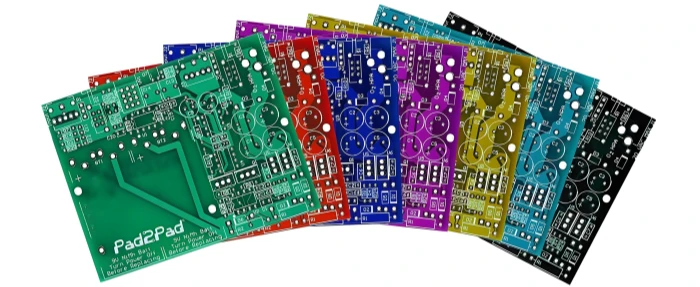
Why are most PCBs green? Is there a scientific reason behind it? What we see as the PCB color is actually the color of the solder mask covering the board’s surface. This layer protects the PCB from oxidation and prevents solder and flux from contacting the copper during the soldering process. Nowadays, many colors of solder mask are available, such as black, white, red, blue, purple, and yellow. Although these colorful boards look impressive, green is still the most common.
#image_title
The Origins of Green FR4 Boards
I remember that FR4 boards were originally green. But why?
Military and Historical Explanations
This question might seem trivial, but some people like to explore such questions. UV-curable solder masks were developed in the U.S. in the 1970s and 1980s when surface mount components were rising in popularity. Based on online research, I’ve found a few possible explanations:
- The military required circuit boards to be painted green. While painting vehicles and communication equipment green makes sense, applying this logic to circuit boards seems far-fetched since nobody runs around the battlefield with a PCB.
- Green is the color of money (U.S. dollars), which seems even more implausible.
- Green is easier on the eyes. This explanation holds some merit, as green is less tiring to look at for long periods. The contrast between green boards, white text, and symbols is also ideal, making it more comfortable for technicians working on boards for extended periods. Green boards, with their gold pads, black ICs, and silver pins, are visually pleasing. Conversely, looking at red boards for too long can strain the eyes.
Development of Green Solder Masks
The early solder mask base material was epoxy resin, which was brownish-yellow, while the curing agent was a deeper brown. When mixed, the resulting color was undesirable. Early researchers tried adding red pigments, but the outcome was a rusty, muddy color. As these colors were unattractive, and PCB laminate materials at the time had a slight green tint, more yellow and blue were added, resulting in an acceptable green color, which became the standard. I find this explanation the most reasonable.
Cost Efficiency and the “Matthew Effect”
Nowadays, producing solder masks in any color is not an issue, so why are more than 90% of PCBs still green? The primary reason is cost. Green ink was the first to be mass-produced, so its production process matured and stabilized, reducing costs through economies of scale. The increasing number of users also contributed to the “Matthew effect,” where the leading product becomes stronger and other colors struggle to compete. This phenomenon is common in business, where factors like history and commercial dynamics often outweigh purely technical aspects when determining the dominant product.
Which PCB Colors Suit Which Fields?
By usage volume:
- Green: Gentle on the eyes for prolonged work, high contrast, cheap, stable process, widely used, and DIY-friendly.
- Red: Chosen primarily for aesthetic reasons, striking and eye-catching, used in motherboards and graphics cards.
- Blue: Lower contrast compared to green, yellow, or red, often used in boards behind LCD displays, e.g., Arduino boards.
- Black: Most expensive to produce, challenging to inspect, lower yield, low contrast, absorbs heat, and is often used in light-sensitive products (e.g., cameras). Black PCBs evoke a sense of mystery, sophistication, and authority (think Apple).
- White: Lowest contrast of all, highest reflectivity but minimal environmental light pollution, suitable for LED lighting products.
Table of Contents
Related Posts
PCBA Prototype
September 8, 2026
PCBA Prototype
August 7, 2026