
Design Standards for Pad Shapes and Dimensions in PCB Package Design
By PCBA PrototypePublished On: 2026-03-22Categories: Blog0 Comments on Design Standards for Pad Shapes and Dimensions in PCB Package Design
By PCBA PrototypePublished On: 2026-03-22Categories: Blog0 Comments on Design Standards for Pad Shapes and Dimensions in PCB Package Design
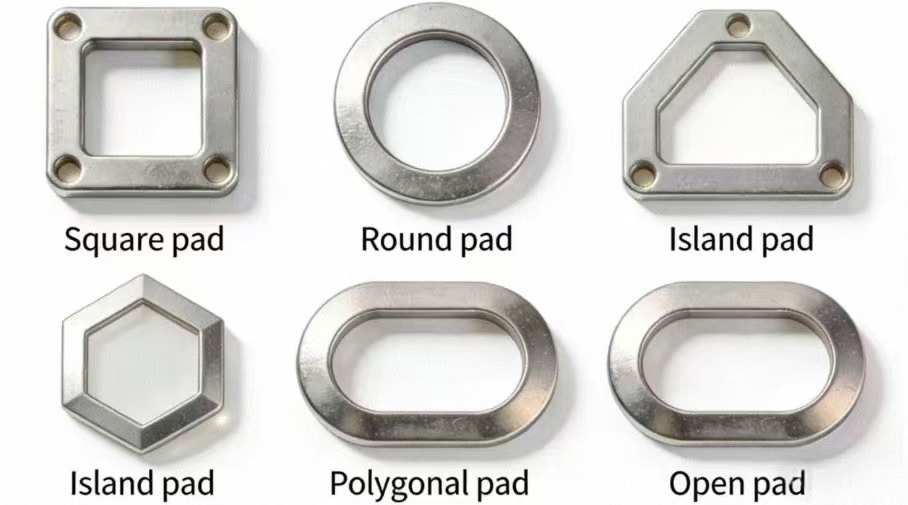
- Pad Types
Broadly speaking, pads can be categorized into seven major types, distinguished by their shape as follows:
- Square Pads — frequently used on printed circuit boards (PCBs) where components are large and sparse, and the printed traces are simple. When fabricating PCBs manually, this type of pad is particularly easy to implement.
- Circular Pads — Widely used in single- and double-sided PCBs where components are arranged in a regular pattern. If the board density permits, the pads can be made larger to prevent them from detaching during soldering.
- Island Pads — Pads where the connecting traces between them are integrated into a single, unified shape. These are often used for vertical components arranged in irregular patterns; for instance, this type of pad is commonly found in tape recorders.
PCB Pad
- Teardrop Pads — Frequently used when the trace connecting to a pad is relatively thin, serving to prevent the pad from lifting (peeling) or the trace from detaching from the pad. These pads are commonly employed in high-frequency circuits.
- Polygonal Pads — Used to distinguish between pads that have similar outer diameters but different hole diameters, thereby facilitating both manufacturing and assembly processes.
- Oval Pads — These pads possess sufficient surface area to enhance peel strength (resistance to detachment) and are commonly used for Dual In-line Package (DIP) devices.
- Open-Type Pads — Frequently used to ensure that, following wave soldering, the pad holes intended for subsequent manual touch-up soldering do not become completely filled (sealed) with solder.
- Design Standards for Pad Shapes and Dimensions in PCB Design
- For all pads, the minimum dimension on any single side must be no less than 0.25 mm, and the overall pad diameter must not exceed three times the diameter of the component mounting hole.
- Every effort should be made to ensure that the spacing between the edges of adjacent pads exceeds 0.4 mm.
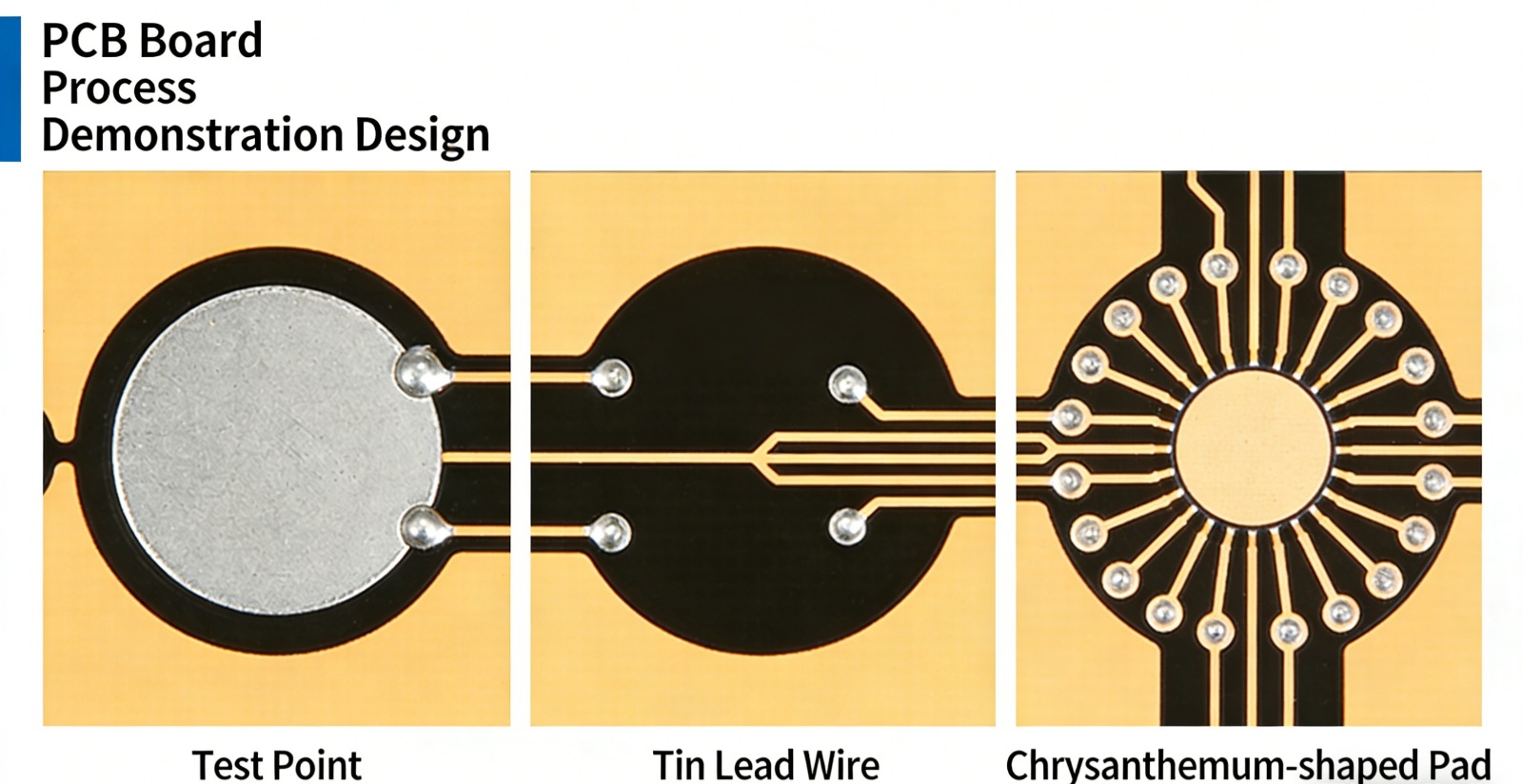
- In situations involving high-density routing, the use of oval or oblong connection pads is recommended. For single-sided PCBs, the pad diameter (or minimum width) should be 1.6 mm; for double-sided PCBs carrying low-current signals, the pad diameter need only be 0.5 mm larger than the hole diameter (oversized pads can easily lead to unnecessary solder bridging). Pads with a hole diameter exceeding 1.2 mm, or a pad diameter exceeding 3.0 mm, should be designed in a diamond or plum-blossom (star-like) shape. 4. For through-hole components, to prevent copper foil detachment during soldering, single-sided pads must be completely enveloped by copper foil; for double-sided boards, the minimum requirement is the addition of “teardrops.”
- All machine-inserted components must be designed with teardrop-shaped pads oriented along the direction of the bent leads to ensure robust and well-filled solder joints at the bend points.
- Pads situated on large areas of copper pour should utilize “thermal relief” (or “daisy-shaped”) pads to prevent cold solder joints. If the PCB contains large ground or power plane areas (exceeding 500 mm²), localized windows should be opened within the copper, or the fill pattern should be designed as a grid.
III. PCB Manufacturing Process Requirements for Pads
- For SMD components where neither terminal connects to a through-hole component, test points must be added. The diameter of these test points should be equal to or greater than 1.8 mm to facilitate testing via In-Circuit Testers (ICT).
- For ICs with fine-pitch leads, if a specific lead pad is not connected to a through-hole component pad, a dedicated test pad must be added. In the case of SMD ICs, these test points must not be placed within the area defined by the IC’s silkscreen outline. The diameter of these test points should be equal to or greater than 1.8 mm to facilitate ICT testing.
- For pads with a pitch (spacing) of less than 0.4 mm, a solder mask bridge (white oil) must be applied between the pads to minimize the risk of solder bridging during wave soldering.
- Both ends (and terminal edges) of SMD components should be designed with solder-wicking extensions (solder thieves). It is recommended to use a 0.5 mm wide trace for this extension, with a typical length of 2 to 3 mm.
- On single-sided PCBs, if manual soldering is required for certain components, a “solder relief slot” (or solder-wicking channel) must be created. This slot should be oriented opposite to the direction of the solder flow during assembly, and its width should range from 0.3 mm to 1.0 mm, depending on the size of the component hole.
- The spacing and dimensions of pads intended for conductive rubber keypads must precisely match the actual dimensions of the corresponding rubber keypad. The mating pads on the PCB must be designed as “gold fingers” (edge connectors), and a specific gold plating thickness must be specified for these areas.
- The dimensions and spacing of pads intended for SMD components must correspond exactly to the physical dimensions of the specific SMD components being used.
PCB Process
Table of Contents
Related Posts

PCBA Prototype
September 4, 2026


PCBA Prototype
September 4, 2026