Can You Mix Different PCB Materials?
Understanding PCB Materials and Their Properties
Not all printed circuit boards are created equal—and the materials you choose fundamentally shape your design’s performance, reliability, and cost. Whether you’re developing a simple consumer device or a complex RF system, understanding PCB substrate materials is the foundation for making informed decisions about when and how to mix PCB materials effectively.
FR-4 remains the workhorse of the PCB industry, offering excellent mechanical strength, flame resistance, and affordability for general-purpose applications. This glass-reinforced epoxy laminate handles most digital circuits admirably, with a dielectric constant (Dk) typically around 4.2-4.8 and loss tangent near 0.02. However, high-frequency PCB materials like Rogers laminates tell a different story. These specialized substrates—including Rogers RO4003C and RO4350B—deliver tighter dielectric constant tolerances (often ±0.05) and significantly lower loss tangents (as low as 0.0027), making them indispensable for microwave and millimeter-wave applications.

Three properties dominate material selection decisions. The dielectric constant determines signal propagation speed and impedance characteristics—critical for controlled impedance traces and timing-sensitive designs. Loss tangent measures how much signal energy dissipates as heat; lower values mean better signal integrity at high frequencies. Finally, the coefficient of thermal expansion (CTE) affects mechanical reliability through thermal cycling. Mismatched CTE values between materials can create stress points, particularly in mixed-material designs where different substrates meet.
These properties aren’t just numbers on a datasheet—they directly impact whether your design meets specifications, passes electromagnetic compatibility requirements, and survives in the field.
Why Mix Different PCB Materials?
Hybrid PCB materials represent a strategic design choice rather than a compromise—combining different substrates within a single board allows engineers to optimize performance zones while controlling costs. Instead of specifying expensive high-frequency materials across an entire board, designers can strategically place premium substrates only where signal integrity demands it.
The most compelling reason to mix materials is cost-effectiveness without sacrificing critical performance. A board handling both RF signals and digital logic presents a perfect case: the RF section might use PTFE-based materials for minimal signal loss at high frequencies, while the digital portion uses standard FR-4 to keep costs reasonable. According to Designing PCBs With Mixed Materials, this approach can reduce material costs by 40-60% compared to using high-performance substrates throughout.
- Common applications for material mixing include:
- RF/digital hybrids where wireless communication circuits coexist with microcontrollers
- High-speed computing boards with specialized memory interface zones
- Automotive systems requiring thermal management in power zones alongside standard logic circuits
- Medical devices balancing sensitive analog sensors with digital processing
Material mixing becomes particularly advantageous when you’re dealing with localized thermal hotspots, distinct frequency domains within one design, or specific impedance-controlled sections. The compatibility considerations between different materials determine feasibility—thermal expansion coefficients and bonding characteristics must align to prevent delamination or warping during manufacturing and operation.
Understanding which material combinations work together reliably becomes the next critical step in your design process.
Common Material Combinations in Hybrid PCBs
The most widely adopted mixed materials PCB approach combines FR-4 with high-frequency laminates like Rogers RO4000 series or PTFE-based substrates. This pairing leverages FR-4’s cost-effectiveness for non-critical digital circuitry while deploying premium materials only where signal integrity demands it—typically in RF transmission paths, antenna feeds, or high-speed differential pairs operating above 5 GHz.
FR-4 and Rogers Hybrid Stack-Ups
Telecommunications equipment manufacturers frequently use FR-4 cores for power distribution and control logic layers, reserving Rogers RO4350B (εr = 3.48) for outer layers handling millimeter-wave signals. This configuration reduces material costs by 40-60% compared to all-Rogers constructions while maintaining tight impedance control where it matters most. According to electromagnetic compatibility research, proper material selection significantly impacts radiated emissions and susceptibility.
Polyimide-FR-4 Combinations
Aerospace and automotive applications often blend polyimide substrates with standard FR-4 layers. The polyimide’s 260°C glass transition temperature protects critical sensor interfaces and power electronics from thermal stress, while FR-4 handles ambient-temperature digital processing. Space-grade PCB designs exemplify this strategy—thermally stable layers shield radiation-hardened components while conventional materials support housekeeping electronics.
Ceramic-Organic Hybrids
High-power LED drivers and RF power amplifiers increasingly adopt ceramic substrates (aluminum nitride or alumina) for heat-generating components, bonded to FR-4 baseboards carrying control circuitry. This thermal management strategy concentrates expensive ceramic material only beneath hot spots, achieving localized thermal conductivity exceeding 200 W/m·K while maintaining overall design flexibility.
These combinations transform specific performance bottlenecks into engineered solutions rather than accepting across-the-board compromises.
Steps to Design a Hybrid PCB Stack-Up
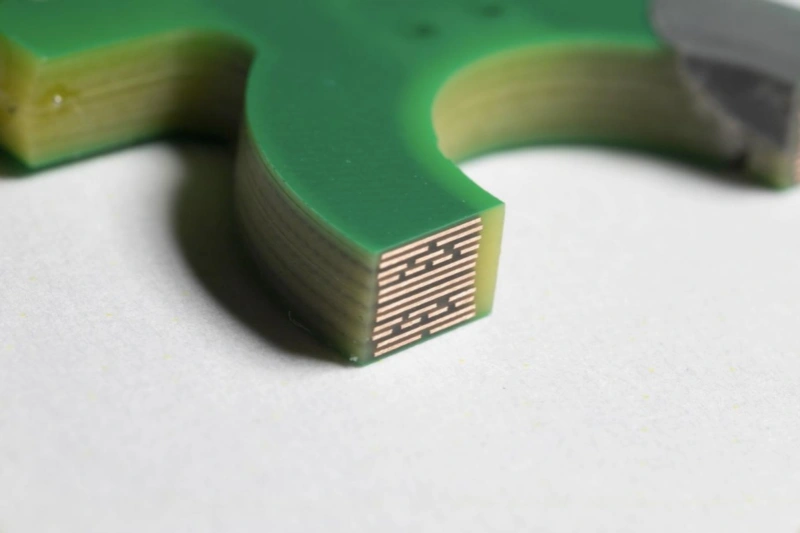
PCB material mixing requires a methodical approach to stack-up design, starting with clear performance requirements. The process begins by mapping circuit functions to appropriate substrate zones—identifying which areas demand high-frequency performance, which need thermal dissipation, and which can utilize standard materials for cost efficiency.
Material Selection Framework
Material selection should balance electrical requirements with mechanical compatibility. High-frequency sections typically use PTFE-based laminates (Dk 2.2-3.5), while power sections may require thermally enhanced substrates with copper-filled vias. Standard FR-4 fills non-critical areas where cost matters more than specialized performance. The key consideration: materials must have compatible coefficients of thermal expansion (CTE) to prevent warpage during temperature cycling.
Interface Layer Strategy
The critical success factor in hybrid designs is the bonding interface between dissimilar materials. Prepreg selection becomes paramount—the adhesive layer must accommodate CTE differences while maintaining electrical integrity. PCBasic’s compatibility criteria emphasize matching glass transition temperatures (Tg) within 20°C and selecting prepregs with flow characteristics that fill gaps without creating voids.
Interface design also dictates via placement. Avoid positioning through-hole vias directly at material boundaries where differential expansion creates stress concentrations. Instead, position transitions in low-stress zones and use staggered via patterns to distribute mechanical loads.
The golden rule: simulate before fabrication. Thermal modeling reveals potential delamination zones, while electromagnetic simulation validates that material transitions don’t create impedance discontinuities. This upfront validation prevents costly redesigns and ensures the hybrid stack-up delivers its intended performance advantages.
Considerations and Limitations of Mixing PCB Materials
While hybrid PCB designs unlock performance advantages, they introduce several technical challenges that require careful planning. Understanding these limitations upfront helps designers create robust mixed-material boards that meet reliability targets.
Material Compatibility Challenges
Thermal mismatch tops the list of concerns when combining dissimilar materials. Different substrates expand and contract at different rates (coefficient of thermal expansion), creating mechanical stress during temperature cycling. According to research on material compatibility in PCB assembly, this stress concentration at material boundaries significantly increases the risk of delamination—where layers separate from each other. What typically happens is that FR-4 and PTFE-based materials experience different expansion rates, potentially causing cracks at interface zones during reflow soldering or operational temperature swings.
Fabrication and Cost Implications
Manufacturing complexity escalates with mixed materials. Standard PCB fabrication equipment and processes aren’t always optimized for handling multiple substrate types simultaneously. Expect 15-30% cost premiums over homogeneous designs, plus longer lead times as manufacturers adjust drilling parameters, via filling techniques, and press cycles for different materials. Smaller fabrication shops may lack the expertise, limiting your vendor options.
Troubleshooting Common Issues
When delamination occurs, review your press temperature and pressure profiles—ensure they accommodate the lowest-rated material’s processing window. For signal integrity problems at material transitions, add guard vias or ground stitching to maintain consistent reference planes. If experiencing via reliability issues, consider electromagnetic compatibility design principles that emphasize proper grounding across material boundaries. Testing thermal cycling behavior early in prototyping reveals potential weaknesses before production commitment.
Example Scenarios: When to Use Mixed Materials
Understanding when to employ hybrid PCB stack-up designs requires examining real-world applications where conventional single-material approaches fall short. Several scenarios consistently demonstrate the value of mixed materials.
High-Speed Digital with RF Integration
Communication systems combining baseband processing with RF front-ends exemplify ideal hybrid candidates. A typical design might use FR-4 for digital logic layers while incorporating Rogers-based materials for antenna feeds and impedance-critical RF paths. This approach maintains signal integrity above 10 GHz while controlling costs on layers handling sub-1 GHz digital signals. When evaluating suitability, calculate what percentage of board area actually requires premium dielectric performance—often less than 20% justifies a mixed approach.
Space-Constrained High-Power Applications
Automotive radar modules and compact base stations face dual challenges: limited footprint and substantial heat dissipation. Spacecraft PCBs demonstrate this principle, where polyimide materials handle thermal cycling in power sections while low-loss substrates maintain signal fidelity in sensor arrays. The key evaluation metric here is thermal conductivity per unit thickness—if power density exceeds 5W/in², mixed materials warrant serious consideration.
Practical Decision Framework
Before committing to mixed materials, quantify three factors: frequency range differential between circuit sections, thermal gradient across the board, and production volume. Projects requiring fewer than 100 units often benefit most, as tooling costs amortize differently than high-volume manufacturing. The complexity premium typically adds 15-25% to fabrication costs but can eliminate the need for separate boards entirely.
Frequently Asked Questions About PCB Materials
What is the 3W rule in PCB?
The 3W rule states that trace spacing should be at least three times the trace width to minimize crosstalk between parallel traces. For example, if your trace is 10 mils wide, maintain at least 30 mils of separation from adjacent traces. This guideline helps reduce electromagnetic interference in high-frequency designs. According to NXP’s electromagnetic compatibility guidelines, proper trace spacing becomes critical when designing for signal integrity, particularly in mixed-material boards where dielectric properties vary between layers.
Why are there no 3-layer PCBs?
Three-layer PCBs are technically possible but impractical for commercial manufacturing. A functional PCB stack-up requires balanced construction to prevent warping during fabrication. Standard designs use even layer counts (2, 4, 6, 8, etc.) with symmetrical copper distribution around the core. Asymmetric three-layer boards would experience significant mechanical stress and warping issues due to unbalanced CTE matching between layers. Manufacturing processes are optimized for even-layer constructions, making them more cost-effective and reliable.
Can PCB traces overlap?
PCB traces cannot physically overlap on the same layer—they would create a short circuit. However, traces on different layers can cross perpendicularly without electrical connection. When designing multilayer boards, especially hybrid designs, route signals on different layers to avoid conflicts. For optimal electromagnetic compatibility, maintain ground planes between signal layers and minimize trace overlap even across layers to reduce capacitive coupling.
Key Mix Pcb Materials Takeaways
Hybrid PCB stack-ups offer compelling advantages when conventional single-material approaches fall short. By strategically combining materials like FR-4 with high-frequency laminates or polyimide, designers achieve optimized performance across diverse circuit requirements—balancing cost with functionality where it matters most.
Success hinges on understanding material compatibility PCB fundamentals. Thermal expansion mismatches, dielectric variations, and manufacturing constraints demand careful attention during design phases. What typically works in single-material boards may require adjustment when introducing hybrid structures.
Implementation requires collaboration between design and fabrication teams early in the process. Documenting material transitions, specifying controlled impedance zones, and validating thermal profiles through simulation prevents costly revisions. The payoff? Boards that meet stringent performance demands without unnecessary expense across every layer.
FAQ
Can you combine FR-4 with high-frequency materials in the same PCB?
Yes, FR-4 hybrid designs successfully combine cost-effective FR-4 with specialized high-frequency laminates in different board areas. The key is managing the thermal expansion mismatch at material boundaries through careful stack-up design and avoiding critical signal transitions at interface zones. This approach works particularly well when only portions of your board require high-frequency performance.
What’s the main challenge with mixed-material PCBs?
The coefficient of thermal expansion (CTE) mismatch creates the most significant challenge. When materials expand at different rates during temperature cycling, mechanical stress concentrates at the boundaries, potentially causing delamination or via fractures. Proper design requires thermal modeling and strategic placement of transition zones away from high-stress areas.
Do mixed-material boards cost significantly more?
Expect 20-40% higher fabrication costs compared to standard FR-4 boards, primarily due to specialized processing requirements and reduced manufacturing volume. However, this often remains more economical than using premium materials throughout the entire board, especially for larger designs where only specific zones require enhanced performance characteristics.
Are there standard stack-ups for hybrid designs?
No universal standards exist—each hybrid design requires custom engineering based on specific performance requirements, operating environment, and manufacturing capabilities. Work closely with your fabricator early in the design phase to develop a viable stack-up that balances performance needs with manufacturability constraints.
Table of Contents
Tags
Related Posts
PCBA Prototype
September 8, 2026