
HDI PCB Copper Plating Process Guide
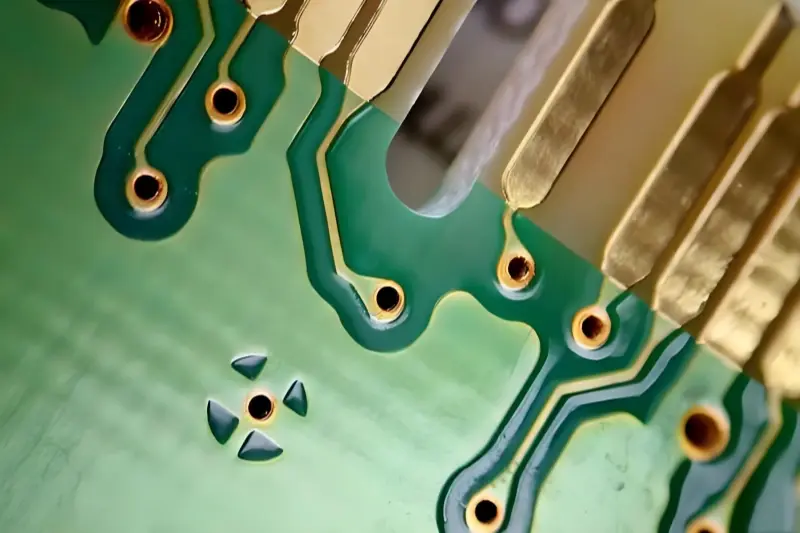
PCB Board Production Demand and Development Trend
With the rapid growth of PCB board demand and the fast development of the industry, the line width and line spacing on the board are getting smaller and smaller. In this case, PCB manufacturing technology faces higher and higher demands. When copper is built up or thickened on the PCB by electroplating, this process is only one step in PCB production, but it is a very important step. The quality of the copper thickness distribution, the plating defects on the via wall, and the filling of blind vias and microvias all directly affect the quality of the PCB.
At the same time, the pretreatment before electroplating, including drilling and pattern transfer, and the etching and stripping after electroplating, also affect product quality. In the whole process, copper plating comes first. Its plating parameters must be optimized, so that product quality in the whole production process and the yield in later steps can be improved. Only in this way can high-quality plated copper layers, vias, and blind microvias be made, and only in this way can the quality of the PCB in later steps be guaranteed.
Traditional PCB Copper Plating Processes
Traditional PCB copper plating uses either panel plating or pattern plating. For high density interconnect boards, or HDI boards, no matter which single process is used, each one has its own strengths and weaknesses.
Advantages of Panel Plating in HDI Production
When panel plating is used in HDI production, the main advantages are as follows:
- The copper thickness on the board surface is more even when the board is made by panel plating. The copper thickness in the holes is related to the plating equipment and the process parameters. In general, when panel plating is used, the parameters are easier to optimize.
- During pretreatment, if dry film remains on the board surface or inside the holes, copper will not be plated on the places where the dry film stays.
- Based on the thickness features of the panel plating layer, it is easier to adjust the etching parameters in the next step after plating.
- In general, the cross section of the lines in panel plating does not change much, or only changes a little. This helps make sure that the impedance after etching meets the product requirement very well.
Disadvantages of Panel Plating
Panel plating also has its own problems:
- The impedance value in NDI depends on pattern transfer, the complexity of the pattern, and the pattern plating process.
- In panel plating, the plated copper layer is etched together with the base copper. Only the line area is left unetched. This leads to side etching, thin line defects, and other quality problems. This is especially true for the dense line area of HDI boards. The etching speed of dense lines is slower than that of isolated lines, so over-etching of isolated lines is hard to avoid.
- During etching after panel plating, a large area of copper on the PCB board is etched away. This increases production cost. At the same time, a large amount of copper ions enters the waste liquid after etching, which causes environmental pollution and makes recycling more difficult.
Advantages of Pattern Plating as a Replacement for Panel Plating
Using pattern plating instead of panel plating has the following advantages:
- After pattern plating, only the base copper is etched away. The copper plated on the pattern is not etched away. This can greatly reduce the risk of side etching.
Disadvantages of Pattern Plating as a Replacement for Panel Plating
Using pattern plating instead of panel plating also has the following disadvantages:
- The thickness tolerance of the plated layer depends on pattern plating, so it is hard to strictly meet the product requirement for characteristic impedance.
- When pattern plating is used to make HDI boards, the resist, that is, the dry film, must have a certain thickness. This thickness is mainly decided by the copper thickness in the hole. But the resist thickness must be at least greater than the copper thickness in the hole. If not, a recessed edge effect will appear. At the same time, because the gap is small, defects such as incomplete development can happen easily. It also makes strong alkaline stripping difficult. This can cause plated layer separation or partial peeling. In the later etching step, defects such as line breaks, notches, and line thinning can appear.
- When pattern plating is used instead of panel plating, the width and spacing tolerance compensation in pattern transfer before plating depends fully on experience.
Combining the Two Processes to Make Up for Their Weaknesses
To make up for the weaknesses of the two processes, the common method in HDI production is to use panel plating first and then pattern plating. In this way, the strengths of the two copper plating processes are combined, and the weaknesses of one process are balanced by the strengths of the other. The details are as follows:
- A thin copper layer is plated on the base copper by panel plating. In this way, during etching, only the base copper and the thin layer from panel plating are etched.
- The thickness of the electro-deposited layer in panel plating and pattern plating can be adjusted based on real needs. This helps the HDI board meet product quality requirements.
- Compared with using only panel plating or only pattern plating, using both copper plating processes makes the etching parameters easier to optimize.
Even though the combined use of panel plating and pattern plating has many benefits in HDI production, it still has some limits, as follows:
- The copper layer that must be etched is still thicker than the copper layer in direct pattern plating on base copper. So side etching is still serious during etching.
- Compared with using only panel plating or only pattern plating, the process flow is more complex when both copper plating processes are used in HDI production. In these flows, there are more possible quality problems and more process handling problems. In the end, this leads to lower yield.
Higher Requirements for Line Width and Line Spacing in HDI
To meet the customer demand for tighter line width and line spacing in HDI boards, one of the most important points in HDI production is this: after etching, the total copper thickness must make the line width and line spacing reach the required values.
For this reason, people usually use pattern plating on thin base copper boards, where the base copper thickness is about 3 µm. On line traces with a width of 20 µm, they plate 30 µm of copper. For IC substrate boards, it is often done like this: on a pretreated substrate, chemical copper is deposited with a thickness of 0.7 to 1 µm, then pattern transfer is done, then pattern plating is used to plate 20 to 30 µm traces, and then flash etching is done. The process control during flash etching is very important. It directly affects the quality of the later product.
No matter whether panel plating is used, pattern plating is used, or panel plating is followed by pattern plating, the uniformity of plated copper thickness is very important. To meet the customer required values, the plating bath must keep providing the copper ions needed for plating without stopping, so that the copper ion concentration in the bath stays stable in a certain range. This means that even during continuous production, copper ions must be added to the bath in time. The method used is insoluble phosphor copper anodes. Only in this way can the copper ions needed for plating be supplied to the bath continuously. This point can be checked in reference 1.
Because the plating bath works continuously, impurities from the previous process, such as organic contamination, and also reducing metals such as iron from the equipment, enter the plating bath. This causes different levels of pollution in the bath and also creates hidden risks for product quality. To improve the quality of plated products, bath maintenance is necessary. Bath maintenance includes carbon treatment and bath filtration. The number of filtration and carbon treatment cycles is related to mass production volume. However, insoluble phosphor copper anodes also have disadvantages:
- They create an anode oxide film. This leads to extra consumption of organic additives in the bath and shortens the service life of the bath.
- Bubbles in the bath may affect the quality of the microvia copper layer on the circuit board and reduce product reliability.
- Doing anode oxidation maintenance or carbon treatment on the bath increases production cost.
To make sure the quality of the bath, the oxide film must be cleaned with high-purity water, or carbon treatment must be done with high-purity activated carbon. In general, the most common bath contamination is excess chloride ions. Under normal plating conditions, the chloride ion concentration should be controlled between 40 and 60 mg/L. If it goes above this range, it will cause bad results.
Still, using high-quality insoluble phosphor copper anodes can reduce the number of anode oxidation and carbon treatment cycles, while low-quality and cheap insoluble phosphor copper anodes cannot.
HDI Production Equipment Features
Because the cost of HDI production lines stays high, it is worth thinking about how to improve the yield of the existing line and how to balance product reliability, product quality, and low cost when raw material prices, especially copper prices, keep rising. All of these are problems that HDI makers face and want to solve. The main points are as follows:
- The plated layer made by electroplating should have even thickness.
- The equipment should have the ability to plate on thin base copper boards with high current density, while keeping the copper thickness even and consistent.
- For HDI vias, microvias, and similar features, the plating bath should have good throwing power.
- For HDI vias, microvias, and similar features, the recess depth should be the smallest among similar plating baths.
- Output can be improved by optimizing the equipment and the plating current density.
- There should be no copper surface contamination. The plated copper surface roughness should be low, and bath contamination should be low.
- An optimized bath can keep the base copper on thin core boards within 1 to 5 µm.
For this purpose, horizontal plating lines were developed. They do not use the standard distribution of insoluble phosphor copper anodes. Instead, they use a sectioned distribution. The feature of this distribution is that different plating sections use rectifiers with different power levels to provide different current densities. This helps make sure that the plated layer on thin base copper is even and consistent.
The rectifier system must have the ability to provide stable DC power, or the ability to do pulse plating. Compared with traditional DC plating, pulse plating can improve the purity of the plated layer, reduce porosity in the plated layer, and improve the uniformity of the plated layer.
Pulse plating is a kind of modulated current plating. In essence, it is DC plating that turns on and off. The on-off cycle is measured in milliseconds. When the current is on, the peak current is several times or even tens of times higher than normal current. This instant high current density lets metal ions be reduced under a very high overpotential. As a result, the plated layer has small grains, high density, and low porosity.
When the current is off, or when it is reversed for a short time, the plating bath around the plated layer and inside the cathode double layer can be adjusted. The instant stop of current makes the outer metal ions move quickly to the area near the cathode. This helps refill the ions in the double layer. It also helps hydrogen or impurities detach and return to the bath. This helps improve the purity of the plated layer and reduce hydrogen embrittlement. The instant reverse current can dissolve too much buildup on the edges of the plated layer. This helps improve the evenness of the plated layer thickness.
To make pulse plating work, it is not enough to have only a pulse power supply that matches the process parameters and the bath. It also needs stronger filtration, vibration, and even ultrasonic stirring. These help improve mass transfer.
Uniformity of Electroplating Thickness Distribution
The uniformity of plating thickness distribution first depends on the plating equipment used, the plating process, and the parameter settings during plating.
Under various optimized conditions, on a horizontal pulse current plating line with high current density, a thin base copper plated board of 18 inch × 24 inch was measured. The measuring points were taken 15 mm from the board edge at the clamped edge and 10 mm from the board edge on the other sides. The results showed that the copper thickness distribution on the board surface was even, the tolerance was within ±10%, and the pass rate was basically above 92%.
Blind Microvia Filling by Electroplating
Electrolytic deposition filling of blind microvias has become the standard method in the circuit board industry for making HDI boards. When this electroplating method is used to fill micro blind vias, the current density must be low enough to suppress Cu²⁺ deposition on areas outside the microvias. For a further discussion of the theory and use of blind via filling by electroplating, please see reference 2.
For HDI production, the plating process must be able to fill blind microvias at will while having no effect on fine lines. The process used is either panel plating or pattern plating.
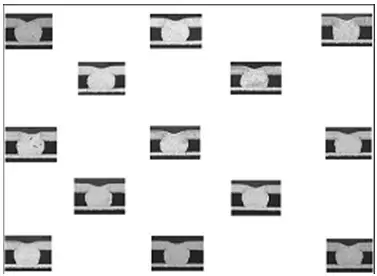
The figure below shows an integrated circuit board made by pattern plating for via filling. In this example of blind microvia filling, a vertical DC plating line with insoluble phosphor copper anodes was used, and all plating parameters were optimized. This made sure that the copper thickness distribution on the board surface was even.
For portable electronic products and integrated circuit substrate boards, through-hole filling on the board surface is not commonly used. For example, a typical PCB board with a through-hole microsection was made by a vertical plating line with insoluble phosphor copper anodes. The plating current was 1.5 A/dm². The results showed that the through-hole filling made by the vertical plating line was as good as blind microvia filling by electroplating, and the quality of blind microvia filling and the copper thickness distribution on the surface were not different from those of electroplated blind microvia filling.
In the figure:
- Board thickness: 1.2 mm
- Blind via diameter: 0.25 mm
New Process: Pulse Plating for Super Filling
Changing the old horizontal DC plating line into pulse plating, with the right electrolyte parameters and special leveling additives, has become a new process in HDI production. By using this new process for super filling blind microvias, the recess depth on the board surface can be controlled within 10 µm.
Test results:
- Blind via diameter: 170 µm
- Blind via depth: 100 µm
- Surface copper plating thickness: 15 µm
The plating bath used in the horizontal pulse plating line with strong reverse pulse current density is fully mixed according to real production needs. This bath can deposit copper smoothly on the board surface, and the product meets reliability requirements.
When this process is used to fill blind microvias and through holes, the thickness distribution of the plated surface layer is even, at 2.5 µm. At the same time, the recess depth must be small. When the recess depth reaches ±5 µm, it is considered unqualified for high quality products.
Thermal Shock Test
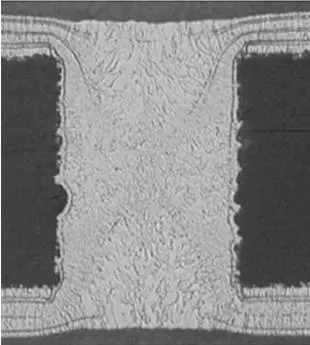
The test results showed that HDI vias filled by electroplating can stand thermal shock cycling after packaging and making the board into a core board. In some cases, for example on a board with a substrate thickness of 60 µm and a base copper thickness of 5 µm, it is also possible to use electroplating to fill through holes with a diameter of 100 µm instead of the old blind microvia method. After this process is combined with laser drilling, production cost is reduced and yield is improved.
Conclusion
In short, using insoluble phosphor copper anode plating in horizontal and vertical plating lines can make the PCB plated layer meet the planned requirements. This is especially suitable for HDI boards used mainly in portable electronic products or IC substrate products.
One clear advantage of this process is that it can keep supplying stable Cu²⁺ ions to the plating bath all the time, so the Cu²⁺ ion concentration in the bath can stay at a certain level. This is very helpful for long-time blind microvia filling.
At the same time, using a horizontal pulse current plating line, and adjusting the bath parameters and plating conditions, is a new process for super filling vias on HDI boards. This process can smoothly fill blind microvias with recess depth less than 10 µm on a 15 µm plated layer. This new process can also make boards with line width and line spacing of 50 µm. The boards made by panel plating also have very even plated layer thickness.
According to research, the semi-additive process, which uses copper plating on thin base copper boards to make IC substrate circuit boards, has become very popular. In the whole board area, the main tasks for chemical copper are to improve the composition of the electroless copper bath, adjust the electroless copper parameters, improve pattern transfer before electroless copper, improve blind via filling after that, and optimize flash etching parameters and the resist performance used in plating.
FAQ
1. What is copper plating in PCB manufacturing?
Copper plating is a key PCB process. It builds copper layers on the board and inside vias to ensure electrical connection and mechanical strength.
2. What is the difference between panel plating and pattern plating?
Panel plating plates copper on the whole board first, then etches. Pattern plating plates only the circuit pattern. Each method has different cost and precision results.
3. Why is microvia filling important in HDI PCB?
Microvia filling improves signal reliability and reduces resistance. It is critical for high density interconnect boards with fine lines and small spacing.
4. How does plating thickness affect PCB quality?
Uniform copper thickness ensures stable impedance and signal performance. Poor thickness control can cause defects and reduce reliability.
5. What is pulse plating in PCB production?
Pulse plating uses controlled current cycles. It improves copper density, reduces defects, and helps achieve better uniformity and microvia filling.
6. What are the main challenges in HDI PCB manufacturing?
Main challenges include fine line control, microvia filling quality, copper thickness uniformity, and process stability.
7. How to improve PCB plating quality?
Quality can be improved by optimizing plating parameters, maintaining the plating bath, using high quality anodes, and controlling contamination.
Table of Contents
- PCB Board Production Demand and Development Trend
- Traditional PCB Copper Plating Processes
- Higher Requirements for Line Width and Line Spacing in HDI
- HDI Production Equipment Features
- Uniformity of Electroplating Thickness Distribution
- Blind Microvia Filling by Electroplating
- New Process: Pulse Plating for Super Filling
- Thermal Shock Test
- Conclusion
- FAQ
Related Posts

PCBA Prototype
September 24, 2024

PCBA Prototype
September 10, 2024