
PCB Final Surface Finish: Electroless Nickel Guide
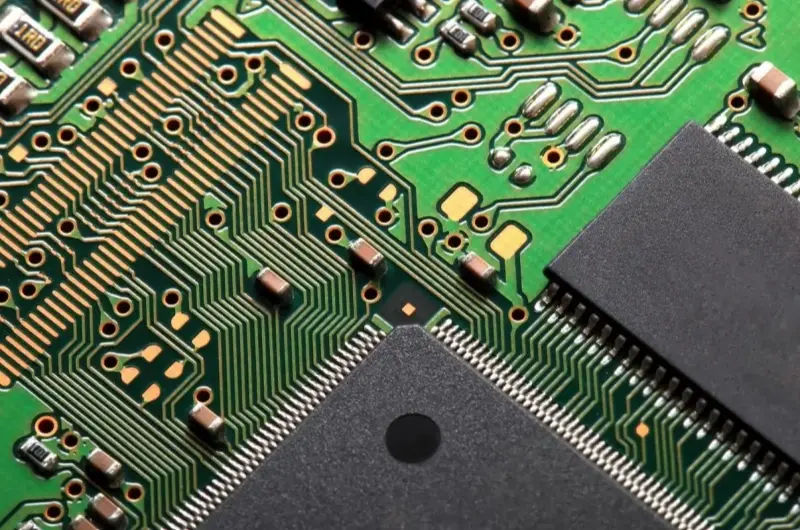
The final surface finish process in PCB manufacturing has gone through major changes in recent years. These changes came from the growing need to solve the limits of HASL (hot air solder leveling) and from the rise of many replacement methods for HASL.
The final finish is used to protect the copper foil on the circuit surface. Copper (Cu) is a very good surface for soldering components, but it oxidizes easily. Copper oxide blocks solder wetting. Today, gold (Au) is often used to cover copper because gold does not oxidize. But gold and copper diffuse into each other very fast. Any exposed copper will soon form copper oxide, and that oxide cannot be soldered.
One solution is to use a nickel (Ni) barrier layer. This layer stops gold and copper from migrating into each other, and it also gives a durable and conductive surface for component assembly.
Requirements for Electroless Nickel Coating on PCB
An electroless nickel coating should complete several functions.
A surface for gold deposition
The final goal of a circuit finish is to build a connection between the PCB and the component that has high mechanical strength and good electrical performance. If there are any oxides or contamination on the PCB surface, this solder joint will not form with today’s weak flux systems.
Gold naturally deposits on nickel, and it does not oxidize during long storage. However, gold does not deposit on oxidized nickel. So nickel must stay clean between the nickel bath and the gold immersion step. For this reason, the first requirement for nickel is that it must stay free of oxidation long enough to allow gold deposition.
Chemists developed electroless plating baths that allow 6% to 10% phosphorus in the nickel deposit. This phosphorus content in electroless nickel coating is a careful balance among bath control, oxide resistance, and electrical and physical properties.
Hardness
The surface of electroless nickel coating is used in many applications that need physical strength, such as automotive transmission bearings. The needs of PCB applications are not as strict as these uses, but some hardness is still important for wire bonding, contact points on touch pads, edge connectors, and handling durability.
Wire bonding needs a certain nickel hardness. If the wire deforms the deposit, friction loss may happen, and this helps the wire “weld” to the substrate. SEM images show no penetration into flat nickel/gold or nickel/palladium (Pd)/gold surfaces.
Electrical Properties
Because it is easy to make, copper is the metal chosen for circuit formation. The conductivity of copper is better than almost every other metal. Gold also has good conductivity, and it is a perfect choice for the outermost metal because electrons tend to move on the surface of a conductive path. This is the “skin effect.”
Copper: 1.7 µΩcm
Gold: 2.4 µΩcm
Nickel: 7.4 µΩcm
Electroless nickel coating: 55–90 µΩcm
Table 1. Resistivity of PCB metals
Although the electrical properties of most production boards are not affected by the nickel layer, nickel can affect the electrical performance of high-frequency signals. Signal loss in microwave PCBs may go beyond the designer’s spec. This effect is proportional to nickel thickness, because the circuit signal must pass through the nickel before it reaches the solder point. In many applications, the electrical signal can be brought back within design spec by limiting the nickel deposit to less than 2.5 µm.
Contact resistance
Contact resistance is different from solderability, because a nickel/gold surface must stay unsolderable during the full life of the final product. Nickel/gold must remain conductive to external contact even after long exposure to the environment. Antler’s 1970 work gave numerical contact requirements for nickel/gold surfaces. Different final-use environments were studied: 65°C, a normal upper temperature for electronic systems that work at room temperature, such as computers; 125°C, the temperature required for general connectors, often specified for military use; and 200°C, a temperature that is becoming more important for flight equipment.
For low-temperature environments, no nickel barrier is needed. As temperature rises, the amount of nickel needed to stop nickel/gold transfer also rises.
Table 2. Contact resistance of nickel/gold (1000-hour results)
| Nickel barrier layer | Satisfactory contact at 65°C | Satisfactory contact at 125°C | Satisfactory contact at 200°C |
|---|---|---|---|
| 0.0 µm | 100% | 40% | 0% |
| 0.5 µm | 100% | 90% | 5% |
| 2.0 µm | 100% | 100% | 10% |
| 4.0 µm | 100% | 100% | 60% |
In Antler’s study, the nickel was electroplated. Better results are expected from electroless nickel, as Baudrand confirmed. However, these results were for 0.5 µm of gold, while planar finishes usually use 0.2 µm. From this, it can be inferred that planar finishes are enough for contact parts that work at 125°C, but parts that work at higher temperatures need special testing.
Antler suggested: “The thicker the nickel, the better the barrier, and this is true in all cases, but the real needs of PCB manufacturing push engineers to deposit only the amount of nickel that is needed.” Flat nickel/gold is now used in cellular phones and pagers that use touch-pad contact points. The spec for this kind of part is at least 2 µm of nickel.
Connectors
Electroless nickel/immersion gold is used in board production for circuits that include spring contacts, press-fit contacts, low-pressure sliding contacts, and other solderless connectors.
Edge connectors need longer physical durability. In these cases, the electroless nickel coating is strong enough for PCB use, but immersion gold is not enough by itself. Very thin pure gold, about 60–90 Knoop, will wear off from nickel during repeated rubbing. After the gold is gone, the exposed nickel oxidizes fast, and contact resistance rises.
Electroless nickel coating / immersion gold may not be the best choice for edge connectors that go through many insertions during the full life of the product. Nickel/palladium/gold is recommended for multipurpose connectors.
Barrier Layer
Electroless nickel has three barrier-layer functions on the board:
- It stops copper from diffusing into gold.
- It stops gold from diffusing into nickel.
- It is the nickel source for the formation of Ni3Sn4 intermetallic compounds.
Copper diffusion through nickel
If copper moves through nickel, copper will reach the surface gold and cause it to break down. Copper will oxidize fast and cause poor solderability during assembly. This happens when nickel is missing in some plated areas. Nickel is needed to stop migration during storage and shipping of bare boards, and also during assembly when other areas of the board have already been soldered. For this reason, the temperature requirement for the barrier layer is less than one minute below 250°C.
Turn and Owen studied the effect of different barrier layers on copper and gold. They found that “…a comparison of copper penetration values at 400°C and 550°C shows that chromium and nickel with 8–10% phosphorus content are the most effective barrier layers studied.”
Table 3. Copper penetration through nickel toward gold
| Nickel thickness | 400°C 24 hours | 400°C 53 hours | 550°C 12 hours |
|---|---|---|---|
| 0.25 µm | 1 µm | 12 µm | 18 µm |
| 0.50 µm | 1 µm | 6 µm | 15 µm |
| 1.00 µm | 1 µm | 1 µm | 8 µm |
| 2.00 µm | No diffusion | No diffusion | No diffusion |
According to the Arrhenius equation, diffusion at lower temperature becomes exponentially slower. Interestingly, in this test, electroless nickel was 2 to 10 times more effective than electroplated nickel. Turn and Owen noted that “…a 2 µm (80 microinch) barrier of this alloy reduces copper diffusion to a negligible level.”
From this extreme temperature test, it can be seen that a nickel thickness of at least 2 µm is a safe spec.
Nickel diffusion through gold
The second requirement for electroless nickel is that nickel must not migrate through the “grain” or “pore” structure of the immersion gold. If nickel touches air, it will oxidize. Nickel oxide is not solderable and is hard to remove with flux.
There are several papers about nickel and gold used on ceramic chip carriers. These materials go through extreme assembly temperatures for long times. A common test for these surfaces is 15 minutes at 500°C.
To judge how well a flat electroless nickel/immersion gold surface stops nickel oxidation, solderability studies were done on thermally aged surfaces. Tests were carried out under different heat, humidity, and time conditions. These studies showed that nickel is well protected by immersion gold, and that good solderability is still possible after long aging.
Nickel diffusion through gold may be a limiting factor in some assembly cases, such as gold thermosonic wire bonding. In this application, nickel/gold surfaces are less good than nickel/palladium/gold surfaces. Iacovangelo studied the diffusion properties of palladium as a barrier between nickel and gold, and found that 0.5 µm of palladium could stop migration even at extreme temperature. This study also showed that no copper diffusion through 2.5 µm of nickel/palladium was detected by Auger spectroscopy after 15 minutes at 500°C.
Nickel-tin intermetallic compounds
During surface mount or wave soldering, atoms from the PCB surface will mix with solder atoms, depending on the diffusion properties of the metals and their ability to form intermetallic compounds.
Table 4. Diffusion rates of PCB materials during soldering
| Metal | Temperature °C | Diffusion rate (µinches/sec.) |
|---|---|---|
| Gold | 450 | 486 |
| Gold | 525 | 117.9 |
| Gold | 525 | 167.5 |
| Copper | 450 | 4.1 |
| Copper | 525 | 7.0 |
| Palladium | 450 | 1.4 |
| Palladium | 525 | 6.2 |
| Nickel | 700 | 1.7 |
In the nickel/gold and tin/lead system, the gold dissolves into the solder very fast. The solder forms a strong bond to the nickel below by forming Ni3Sn4 intermetallic compounds. Enough nickel should be deposited to make sure solder will not reach the copper below. Measurements by Bader showed that no more than 0.5 µm of nickel is needed to keep this barrier layer, even after more than six thermal cycles. In fact, the maximum observed intermetallic layer thickness was less than 0.5 µm (20 microinches).
Porosity
Electroless nickel/gold has only recently become a common final PCB surface finish, so industrial processes may not fit this surface well. There is now a nitric vapor test used for porosity testing of electroplated nickel/gold for edge connectors (IPC-TM-650 2.3.24.2). Electroless nickel/immersion gold does not pass this test. A European porosity standard using potassium ferricyanide has been developed to judge the relative porosity of planar surfaces, and the result is given as the number of pores per square millimeter (pores/mm²). A good planar surface should have fewer than 10 pores per square millimeter at 100x magnification.
Conclusion
The PCB manufacturing industry is interested in reducing the amount of nickel deposited on boards because of cost, cycle time, and material compatibility. The minimum nickel spec should help stop copper from diffusing to the gold surface, keep good solder joint strength, and keep contact resistance low. The maximum nickel spec should allow more flexibility in board production, because there are no serious failure modes linked to thick nickel deposits.
For most board designs today, 2.0 µm (80 microinches) of electroless nickel coating is the minimum nickel thickness required. In real production, a range of nickel thickness will be used in one lot of PCB production. The change in nickel thickness will come from changes in bath chemistry and changes in the dwell time of the automatic lifting machine. To make sure the minimum value of 2.0 µm is met, the end-user spec should ask for 3.5 µm nominal, with a minimum of 2.0 µm and a maximum of 8.0 µm.
This range of nickel thickness has already been shown to work well for the production of millions of circuit boards. The range meets solderability needs, shelf life needs, and contact needs for today’s electronic products. Because assembly needs are different from one product to another, the surface finish may need to be optimized for each special application.
For broader Surface Finish guidance, see Surface Finish overview.
Table of Contents
Related Posts

PCBA Prototype
October 7, 2024