
One-Sentence PCB Insights
In the process of learning about high-speed PCB signal integrity, there are a few key points that help grasp the essence and critical aspects of the subject. Many problem analyses can be distilled into a few simple principles and rules, making them easier to apply and think about in practice compared to complex theories. The following insights are personal reflections, and everyone may have different experiences; if anyone has more practical insights, feel free to share.
Use Controlled Impedance PCB Traces
This principle runs throughout the entire theory of signal integrity and practical wiring work. I believe it’s something to always remember.
Shielded Wires as Extensions of the Enclosure
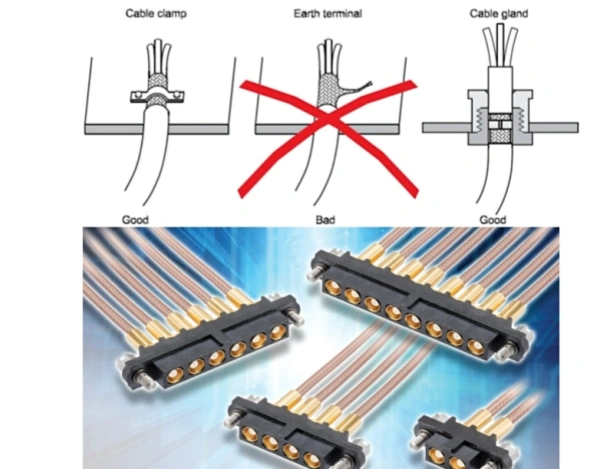
Specifically, the conductor of the shielded wire should be viewed as an extension of the metal enclosure. This understanding has greatly helped me comprehend shielded wires and their connections. The shielding principle of metal spheres or enclosures is relatively easy to grasp. The concept of shielded wires may be more complex, but if you see it as an extension of the enclosure, it becomes much easier to understand related issues. For instance, if the shield has gaps or holes, you can guess what might happen.
What constitutes a good shielded wire? The best shielded wire should resemble a closed tube that appears to have been stretched from the enclosure. Therefore, hard-shelled high-pressure coaxial tubes provide the best shielding effect, though they have the disadvantage of being large. Their rigid casing makes installation difficult, which led to the development of flexible, semi-rigid coaxial cables. Further pursuing flexibility, we have braided coaxial cables or aluminum foil coaxial cables. Although these are flexible, it’s easy to imagine that braided shielding inevitably has holes, reducing the shielding effectiveness. Nonetheless, we should connect the shielding layer to the enclosure in a 360-degree manner, tightly enveloping the signal lines and leaving no gaps.


Understanding the shielding layer as an extension of the enclosure also clarifies that both ends of the shielded wire should connect to the enclosure and do so as quickly as possible. This means grounding the cable immediately upon entry into the enclosure, which is preferable to connecting a segment of wire to ground after entering the chassis.
Any Conductor is an Intentional or Unintentional Antenna
Noted signal integrity expert Dr. Bogatin once said, “There are two kinds of engineers: those who are building antennas on purpose, and those who are building them, but not on purpose.” This highlights the same point. This statement reminds us that all conductors on a PCB need to consider radiation issues. An antenna is essentially a conductor or a combination of conductors, characterized by specific dimensions or shapes that can efficiently transmit or receive electromagnetic waves. Unintentionally created antennas are no different from professional antennas; they share the same technical characteristics and efficient electromagnetic wave emissions. For example, if one end of a conductor has a low-resistance excitation and the other end has a high-resistance load, and if the conductor length is an integer multiple of a quarter wavelength, it can function as an efficient antenna.

#image_title
Typically, we do not design antennas; rather, we focus on PCB circuit layout. To counteract this, we aim to create the least efficient radiating antennas or to completely avoid using conductors, such as through light signal propagation, which is what we care most about. Remembering that any conductor can become an antenna, either intentionally or unintentionally, can guide us to study antenna principles in reverse, potentially aiding our PCB design to reduce noise, minimize EMI, and pass EMC tests.
Designing the least efficient antennas is also a skill. My understanding is that to reduce electromagnetic wave emissions, we must do the opposite of what antennas do. First, the length of the conductor must be much smaller than the wavelength. If the length approaches one-tenth of the wavelength, it may become an efficient antenna. Second, the conductor should not be open like an antenna; instead, it should be closely aligned with the ground line, concentrating all electromagnetic waves within the space formed by the conductor and ground line to prevent leakage.
Table of Contents
Related Posts
PCBA Prototype
September 8, 2026
PCBA Prototype
August 7, 2026