
PCB Pilot Build: What to Verify Before Moving from Prototype to Production
A working prototype shows that a particular assembly performed the checks you gave it. A PCB pilot build asks a different question: can the approved design be built, inspected and tested through the process planned for the next batch?
The answer depends on more than the number of boards. A useful pilot identifies the design revision, materials, manufacturing route, test limits and decisions the team needs before ordering or releasing more units. It also makes unresolved problems visible while there is still an opportunity to correct them.
For engineering teams and buyers, the most useful starting point is a short list of questions: What must this build prove? What would stop it? Who can approve a change?
What Is a PCB Pilot Build?
A pilot build is a limited production run used to assess an agreed design and manufacturing process before a larger or repeat order. It can expose issues in materials, setup, assembly, inspection, programming or test that were not obvious on an engineering prototype.
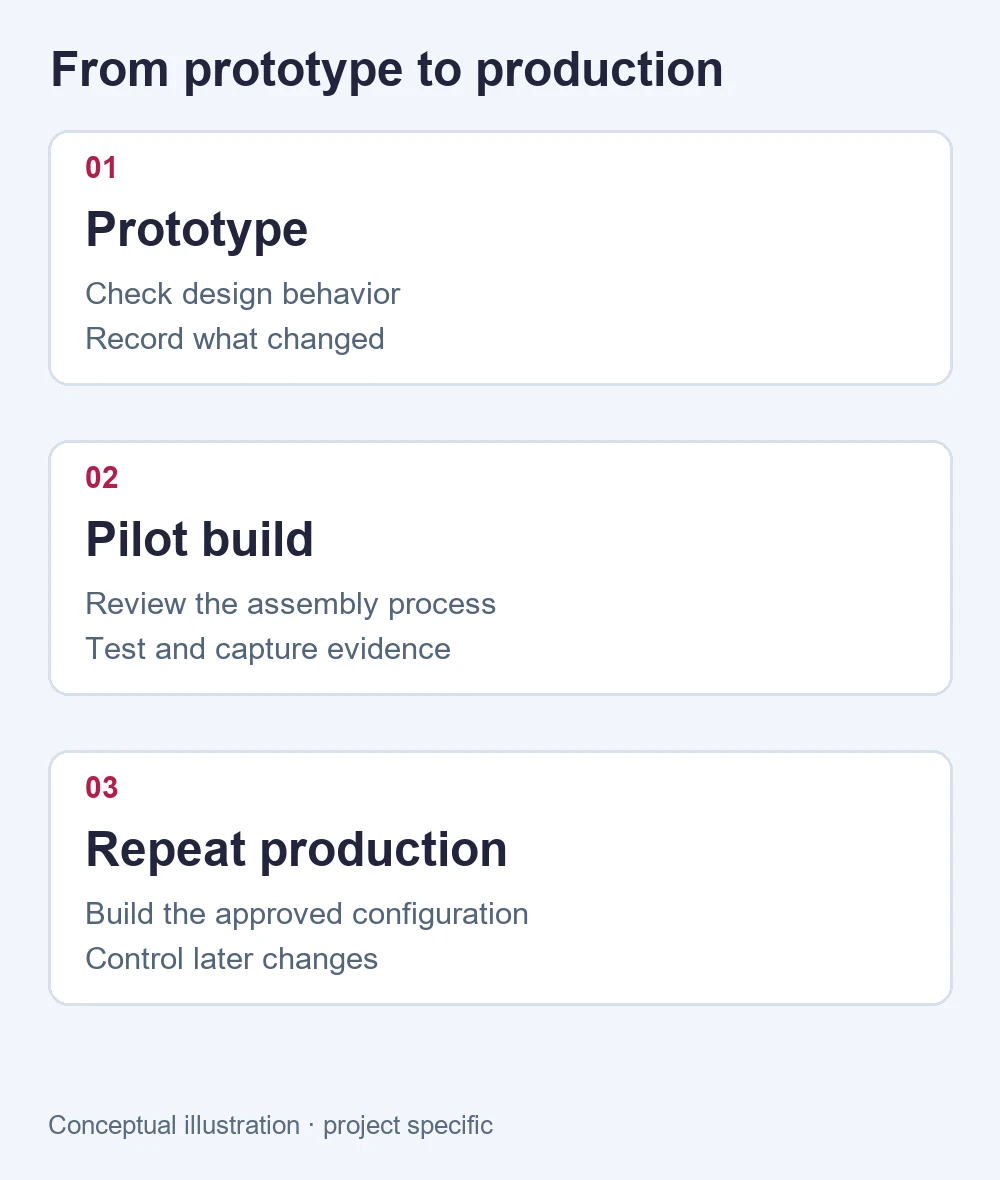
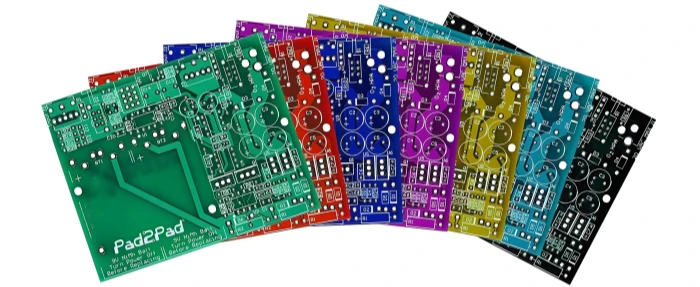
A pilot connects prototype learning with the checks planned for repeat production. Conceptual illustration.
The pilot does not automatically qualify a product for every operating environment or prove that all future boards will pass. Its value comes from choosing representative conditions, defining checks and acting on the results.
| Stage | Main question | Evidence to retain |
|---|---|---|
| Engineering prototype | Does this version work under the conditions we checked? | Board and firmware revision, test conditions, results and outstanding changes |
| Pilot build | Can the released configuration be built and verified using the planned route? | Material identity, setup, inspection, test results, deviations and decisions |
| Repeat production | Can subsequent batches follow the approved requirements? | Controlled files, change records, agreed inspection results and traceability |
The boundaries vary by project. A small repeat order may need the same discipline as a larger one if a wrong component or untested function would be costly to correct.
Start with the Decisions the Pilot Needs to Support
Before choosing a quantity, define what the team needs to learn. A pilot involving a new enclosure might need connector mating and clearance checks. A board with a newly defined programming process might need verification that each unit receives the correct firmware and configuration.
| Decision | What to agree before the build | Example of a hold |
|---|---|---|
| Can purchasing proceed? | Approved part numbers, supply responsibility and substitution authority | A critical part is unavailable and the proposed alternative is not approved |
| Can assembly start? | Matching fabrication files, BOM, placement data and assembly instructions | The released BOM and assembly drawing describe different variants |
| Can the remaining pilot boards proceed? | First-article checks, acceptance criteria and who approves the result | A polarized part is installed opposite to the approved drawing |
| Can the next batch be released? | Pilot evidence, open issues and decisions on changes | The functional test procedure does not cover a required interface |
The customer’s design owner, purchasing team and manufacturer have different responsibilities. Identify the decision maker for each issue in advance; a production operator should not have to guess whether a proposed component change is electrically acceptable.
Establish One Released Build Configuration
The approved prototype is a useful starting point only if the next team knows exactly what it contained. Record the PCB revision, populated variant, BOM, assembly drawing, firmware and test procedure associated with the accepted sample.

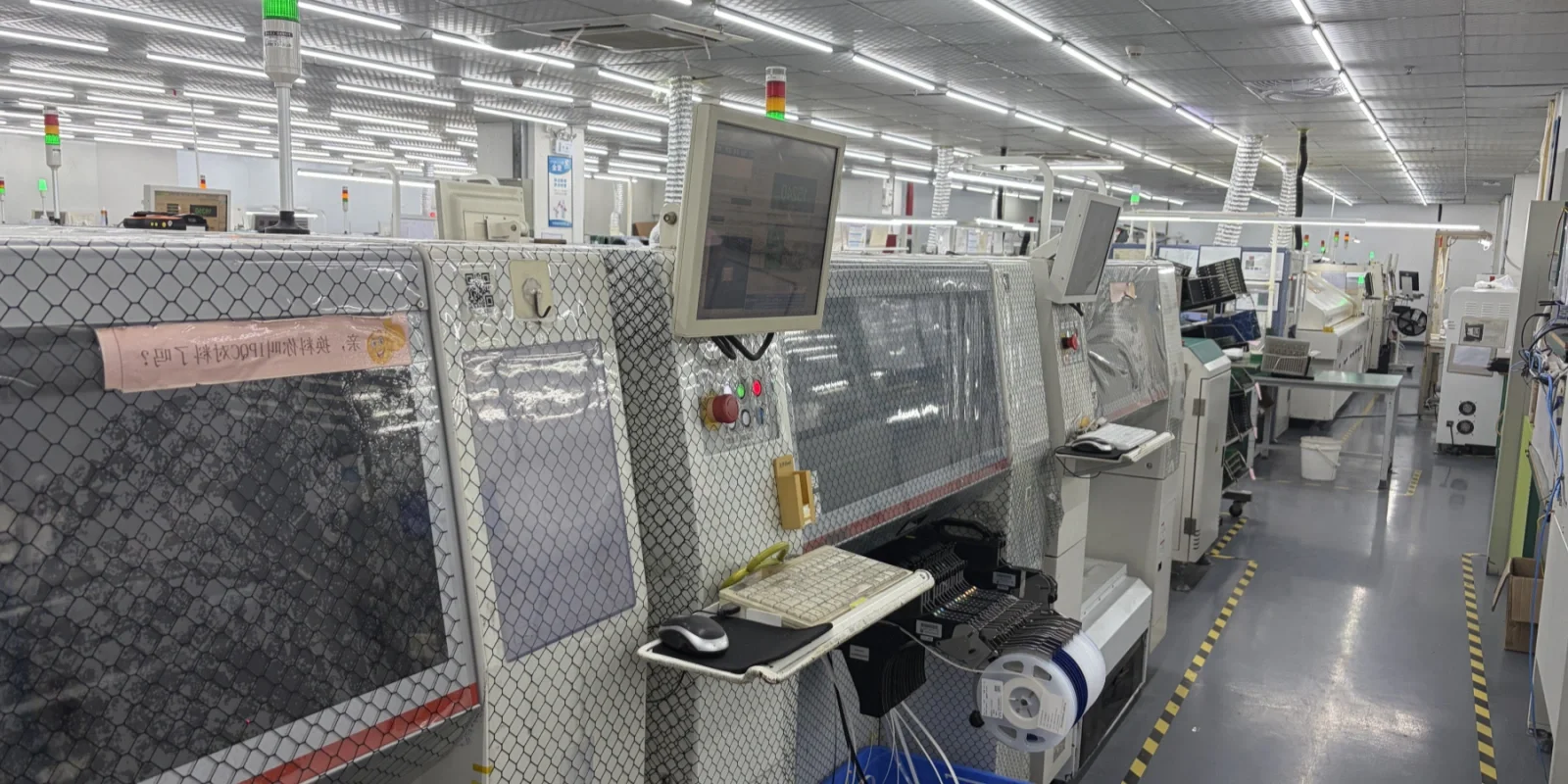
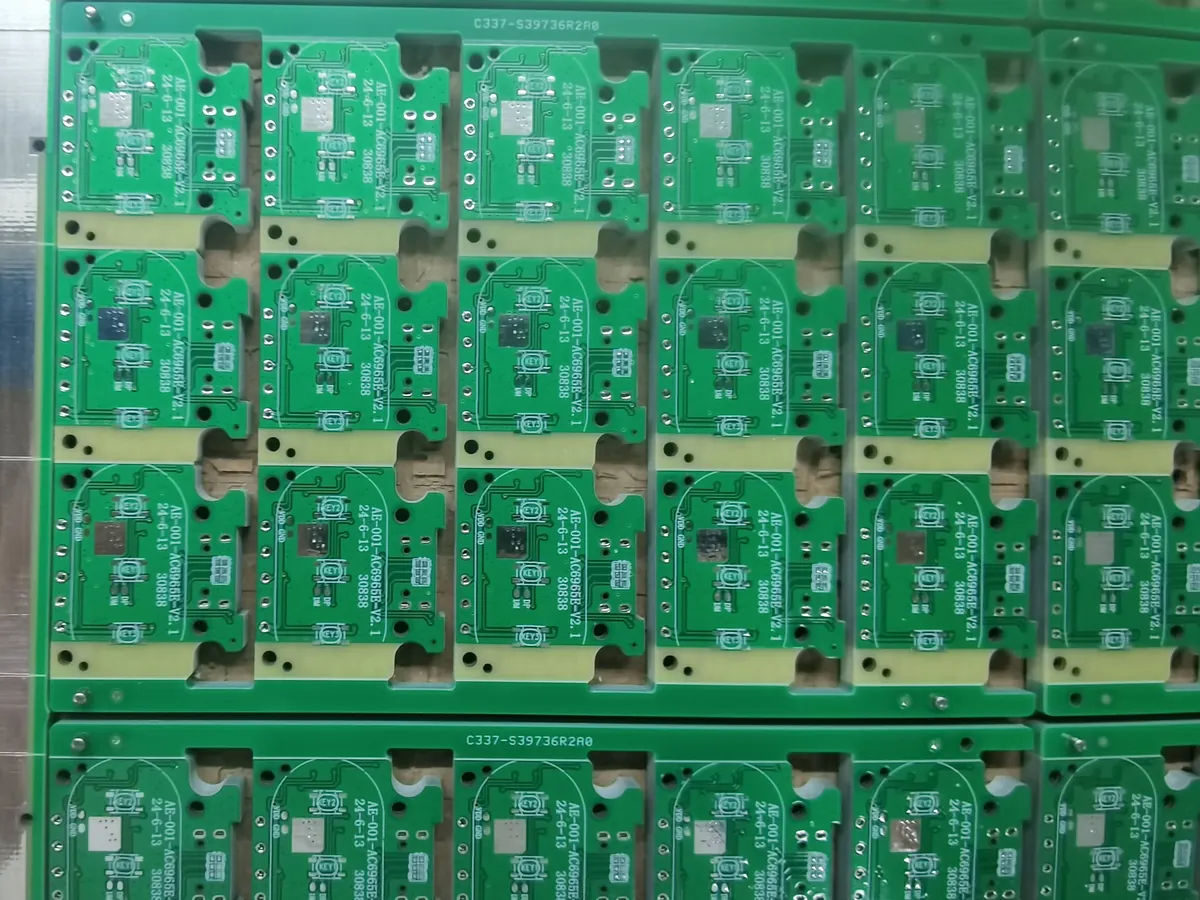
A production line illustrates the manufacturing context for a released assembly configuration.
Reconcile the files
Compare the Gerber and drill package, BOM, placement file and assembly drawing. Check that the reference designators and do-not-populate instructions refer to the same variant. Placement data should identify its units, origin, board side and rotation convention.
For practical file details, see our PCB BOM guide and pick-and-place file guide. These files answer different questions: a BOM identifies the intended parts; placement data describe their positions and orientations.
Close prototype workarounds
Wire links, hand-changed components and firmware settings can make a prototype work without being reflected in the manufacturing package. For each workaround, decide whether to incorporate it into the released design, document an approved assembly instruction or remove it after verification.
A photograph of the prototype can help explain the change, but it is not a substitute for a controlled drawing, BOM or test requirement.
Check Material Readiness and Substitution Rules
An IC that is available for a handful of prototypes may not be available in the quantity or packaging needed for a repeat build. Review critical parts early, including exact manufacturer part numbers, quantity, approved sources and alternatives.
Same package does not mean interchangeable
A proposed replacement can fit the same footprint yet have a different pinout, voltage range, programming method or operating behavior. Compare the relevant data sheets and product requirements, then obtain the design owner’s approval before treating the alternative as part of the build.
For example, if a replacement regulator shares the package outline but swaps two pins, the PCB footprint may physically accept it while the circuit connection is wrong. The affected BOM line and design need engineering review; purchasing availability alone cannot authorize the change.
Record the original and proposed part numbers, affected references, decision, version and any additional verification. A sourcing decision and a design approval are related but separate steps.
Plan customer-supplied material
If the customer supplies parts, identify their part numbers, labels, packaging, quantities and expected arrival. Discuss practical handling allowances with the assembler for the actual components and process. Confirm what should happen to unused material after the build.
Review the Assembly Route Before the First Board
The pilot should represent the next planned build closely enough to answer the chosen questions. Review the board and panel handling, stencil and placement preparation, SMT and through-hole sequence, special processes and inspection points.
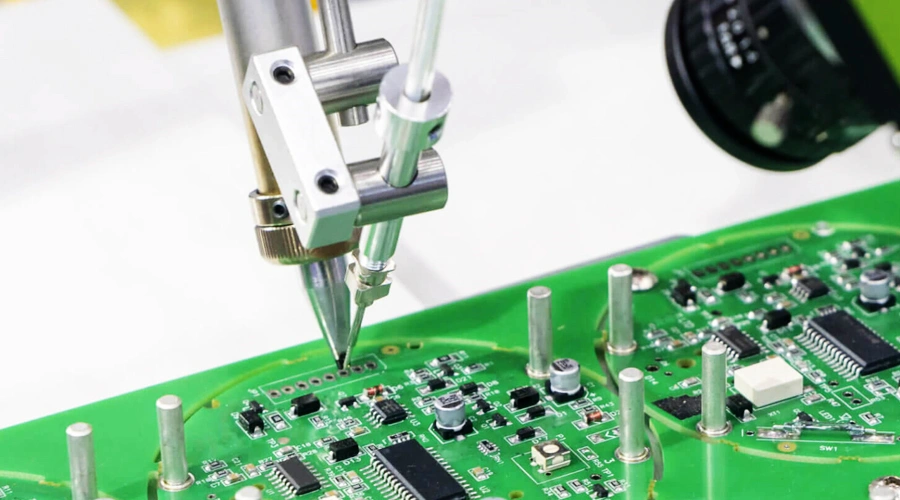
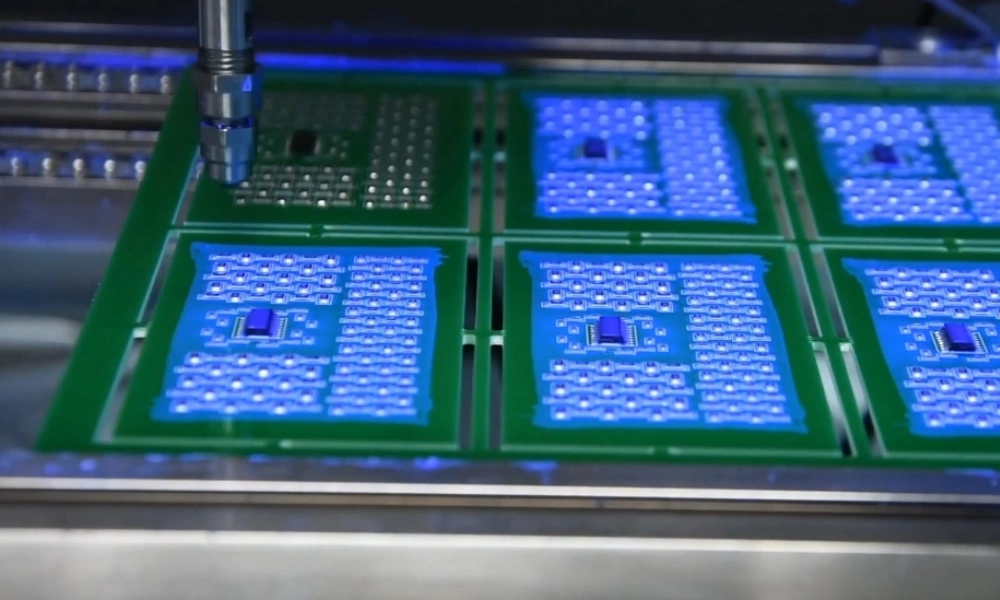
An automated tool above a populated circuit board. Illustrative image from the existing site library.
Look for problems that a bench prototype can hide
- Placement and orientation: compare pin-one and polarity information across the component data sheet, released drawing and placement setup.
- Footprint and access: check whether connector bodies, nearby components or panel edges interfere with placement, soldering or inspection.
- Mixed assembly: identify which parts are inserted later and whether nearby components restrict the selected soldering operation.
- Programming and test: verify that interfaces, firmware and test connections remain accessible on the assembled board.
A manufacturability review helps identify process questions; it does not establish that the circuit meets every product requirement. If GreatPCB is handling both SMT and leaded parts, discuss the intended route through our through-hole and mixed-technology assembly page.
First Article, AOI and Functional Test: What Does Each Check Prove?
The term first-article inspection can describe different agreed scopes. Identify the sample, released configuration, checks, acceptance criteria, records and approval point for the order. Do not assume a first-article review automatically includes a powered functional test.
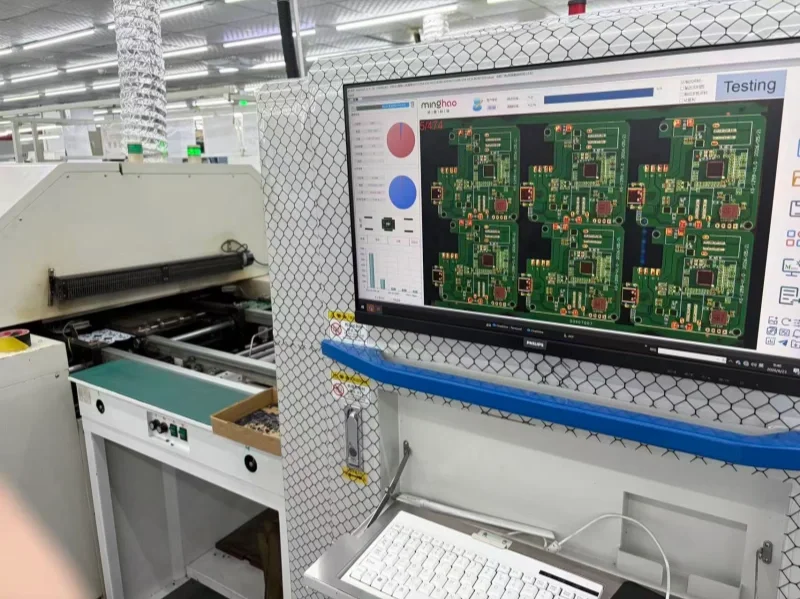
Inspection methods answer different questions about a board. Illustrative site-library photograph.
| Check | Question it can address | Limit |
|---|---|---|
| First-article review | Does the selected assembly match the agreed configuration and checks? | Its conclusion applies to the stated sample and inspection scope |
| AOI | Do programmed visible features match the inspection criteria? | Hidden joints, component electrical values and firmware may need other checks |
| X-ray inspection | Are selected hidden features or joints acceptable under the agreed criteria? | It does not by itself establish complete circuit function |
| Electrical or functional test | Does the circuit meet specified electrical or operating limits? | It only covers the functions and conditions actually tested |
QueenEMS compares first-article inspection with AOI, including the limits of each approach. Our assembly testing overview explains additional inspection and electrical test options.
When the first board looks right but fails a test
Suppose a controller passes its agreed visual checks but does not answer a communication command during a powered test. The visual result remains useful, but it does not identify the cause of the failed command.
Check the released firmware and configuration, test connection, supply and expected response against the procedure. Then investigate the affected circuit and record the result. The right response may be a corrected test setup, a manufacturing repair or an engineering change; the failure alone does not establish which one is responsible.
If the board is repaired, define how it will be inspected and retested, and whether the same issue could affect other boards already built. The release decision should refer to the agreed criteria and the actual disposition.
A practical failure record
Record the board serial or sample ID, PCB and firmware revisions, test step, measured result, expected limit and test setup. For example, if the procedure requires a reply to a command within a defined interval, save the command, interface settings and observed response rather than recording only “communication failed.”
The test engineer can repeat the step with a verified connection and record whether the failure follows the board or the test setup. If the setup is corrected, agree which affected boards need retesting. If the issue points to a component, assembly or design change, involve the responsible engineer before deciding how to handle boards already built. A repeat pass does not erase the original failure or establish its cause on its own.
Choose a Pilot Quantity Around the Risk
There is no single pilot quantity that suits every design. Consider the number of variants, the process steps being evaluated, material lots, critical interfaces, planned tests and the evidence needed for the next decision.
For a straightforward repeat build, a small number may answer the agreed setup questions. A complex product with several variants or test paths may need a different plan. Discuss the purpose of the sample with the manufacturer instead of selecting a quantity only because it appeared in another project.
Even if every board in a small pilot passes, that result does not by itself prove a particular long-term failure rate or guarantee the next batch. Review what was tested, which conditions were covered and whether the production configuration will remain representative.
What Happens When Something Changes After Approval?
A pilot approval is tied to the configuration and checks that were reviewed. A changed PCB revision, substitute component, firmware version, test limit, production location or process may alter what the earlier result demonstrates.
| Change | Questions for the next review |
|---|---|
| Replacement component | Does it match the relevant electrical, mechanical and operating requirements? Is the BOM approval recorded? |
| PCB or assembly revision | Which drawings, programs, stencils or inspection references are affected? |
| Firmware or test procedure | Do the programmed image and pass/fail limits still match the product requirement? |
| Manufacturing process or tooling | Does the earlier sample represent the new process, and what checks should be repeated? |
Not every change requires repeating every test. The design owner and manufacturing team should assess the impact and agree on the necessary verification before the affected work proceeds.
Example: firmware changes after the pilot
Suppose a pilot passed with firmware revision A, then a communication fault is corrected in revision B. The team should identify which boards were programmed with each revision, what the change affects and whether the programming instructions, test software or acceptance limits also changed.
The design owner determines the scope of functional verification for revision B; the assembly team confirms how the approved file will be identified and loaded. A targeted retest may be appropriate for some changes, while others affect enough functions to require a broader plan. Record the decision and test evidence before treating revision B as the released build.
What Should the Pilot Release Record Include?
Keep the record useful to the people preparing the next build. Depending on the project, it can include:
- Board and assembly identification, revision and variant.
- Approved BOM, alternatives and material responsibilities.
- Manufacturing and assembly files, firmware and test procedure revisions.
- Agreed first-article, inspection and functional test results.
- Deviations, repairs, retest results and unresolved issues.
- The decision, scope of release and the people responsible for approvals.
Where a customer contract requires a formal first-article report or an applicable industry standard, agree on the required records before production. A general checklist should not be presented as proof that a specific standard has been met.
Frequently Asked Questions
Is a pilot build the same as a prototype?
They can overlap, but their questions differ. A prototype commonly helps investigate or validate a design; a pilot focuses on building and verifying an agreed configuration through a proposed production route.
Does a passed first article mean every board will pass?
No. It supports a decision about the sample and checks within its agreed scope. The remaining batch still needs the inspection and testing defined in the quality plan.
Do all pilot boards need functional testing?
The frequency and coverage depend on the product, risk and purchase agreement. Define which functions, conditions and pass/fail limits apply and who supplies the procedure and equipment.
Can a pilot use customer-supplied components?
Yes, if the sourcing arrangement and handling requirements are agreed. Identify the supplied part numbers, quantities, packaging and approved alternatives before the build.
Can we order production immediately after the pilot?
That depends on the pilot objectives, results and open issues. Confirm the released configuration, resolve or formally disposition deviations, and agree on the next batch’s requirements.
Discuss Your Next PCB Assembly Build
Share the accepted prototype revision, current BOM, intended quantities and the issues you want the pilot to address. Include any inspection, firmware and test instructions that matter to your product.
GreatPCB can review the project scope alongside its low-volume PCB assembly service and discuss the information needed for a quotation and build plan.
Table of Contents
Tags
Related Posts
PCBA Prototype
October 29, 2026
PCBA Prototype
October 27, 2026
PCBA Prototype
October 23, 2026